
 Expeditions Unlimited blog
Every hiker or mountaineer on the way to the Everest base camp has, at one time or another, marvelled at Ama Dablam, this perfect pyramid. For mountaineers and all enthusiasts, we have designed this feature on Ama Dablam to tell you everything about this queen of mountains, from its first ascent to the one you will make. Everything is reviewed in this six-article feature, from the detailed route to the ideal preparation, to help you prepare your ascent of Ama Dablam at 6812 metres in Nepal.
A perfect pyramid at 6812 metres
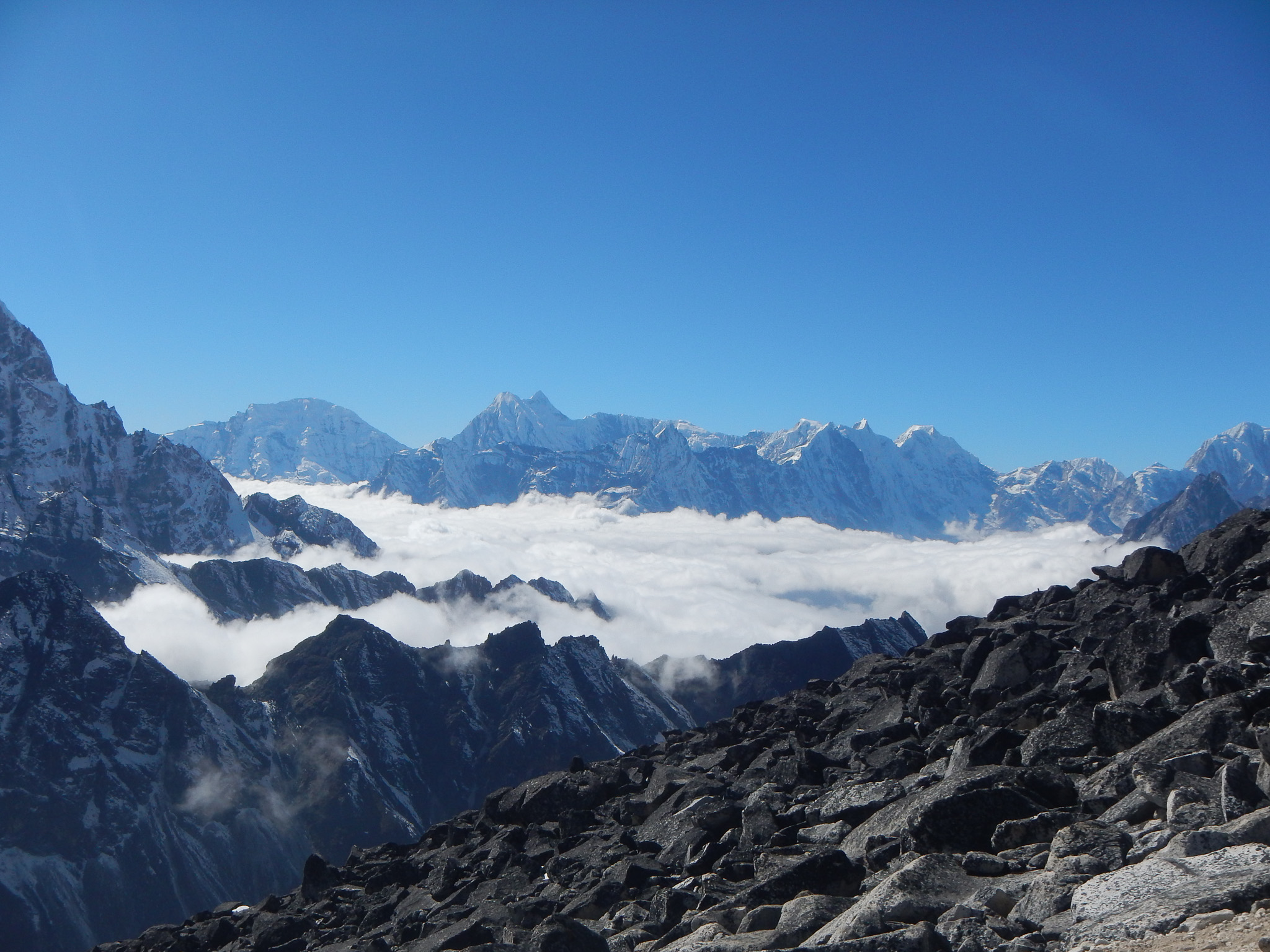
Ama Dablam lies a few days' walk from the famous Everest base camp, in Sagarmatha National Park, a region listed as a UNESCO World Heritage Site. Gateway to the Khumbu, Ama Dablam rises to 6812 metres. Its name means "mother's necklace", as its shape evokes the protective arms of a mother (Ama in Nepali), symbolised by its long ridges, while the hanging glacier represents the dablam, a traditional Sherpa pendant containing sacred images. For the Sherpas and the inhabitants of the Khumbu, Ama Dablam is not only a mountain but also a spiritual symbol. In their belief, the mountain protects the region, and it holds a special place in local tales and legends. The "Matterhorn of the Himalayas" to some, this prestigious summit is immortalised on the one-rupee Nepalese banknote, a symbolic testament to its cultural importance for Nepal.
© David Ducoin
First ascent by the expedition led by Sir Edmund Hillary
During the winter of 1960–1961, Sir Edmund Hillary leads an expedition into the upper Khumbu to study human adaptation to altitude and to search for the legendary yeti. While the creature remains nowhere to be found, the team achieves an unexpected feat: the first winter ascent of Ama Dablam.
After climbing up the Rolwaling valley, they cross the Trashi Lapsha pass and set up an observation camp before tackling the ascent in February. Despite the extreme cold and technical sections such as the Yellow Tower, they progress methodically. On 13 March 1961, Barry Bishop, Michael Gill, Wally Romanes and Michael Ward reach the summit by the south-west ridge.
During the descent, they come to the aid of the Sherpa Gumi Dorje, injured by a rockfall. Although the yeti hunt fails, this winter ascent marks a milestone in the history of mountaineering and strengthens Hillary's reputation in the Himalayas.
When to climb Ama Dablam
Ama Dablam is the third most sought-after summit in the Khumbu region, after Island Peak and Lobuche Peak. The majority of permits are issued during the autumn. However, Ama Dablam lends itself to climbing during two main seasons, spring and autumn, or even winter for the most ambitious.
The best periods for climbing Ama Dablam are autumn and spring. While autumn (October–November) is the most popular season, in spring (mid-April to May) the mornings are fine and clear, while in the afternoons the weather clouds over with snowfall of varying amounts and a sharp drop in temperatures. Although the first ascent of Ama Dablam was achieved in the depths of winter, this season proves difficult on account of the intense cold and violent winds.
© Bruno Serraz
Choice of trekking routes from Lukla to the base camp
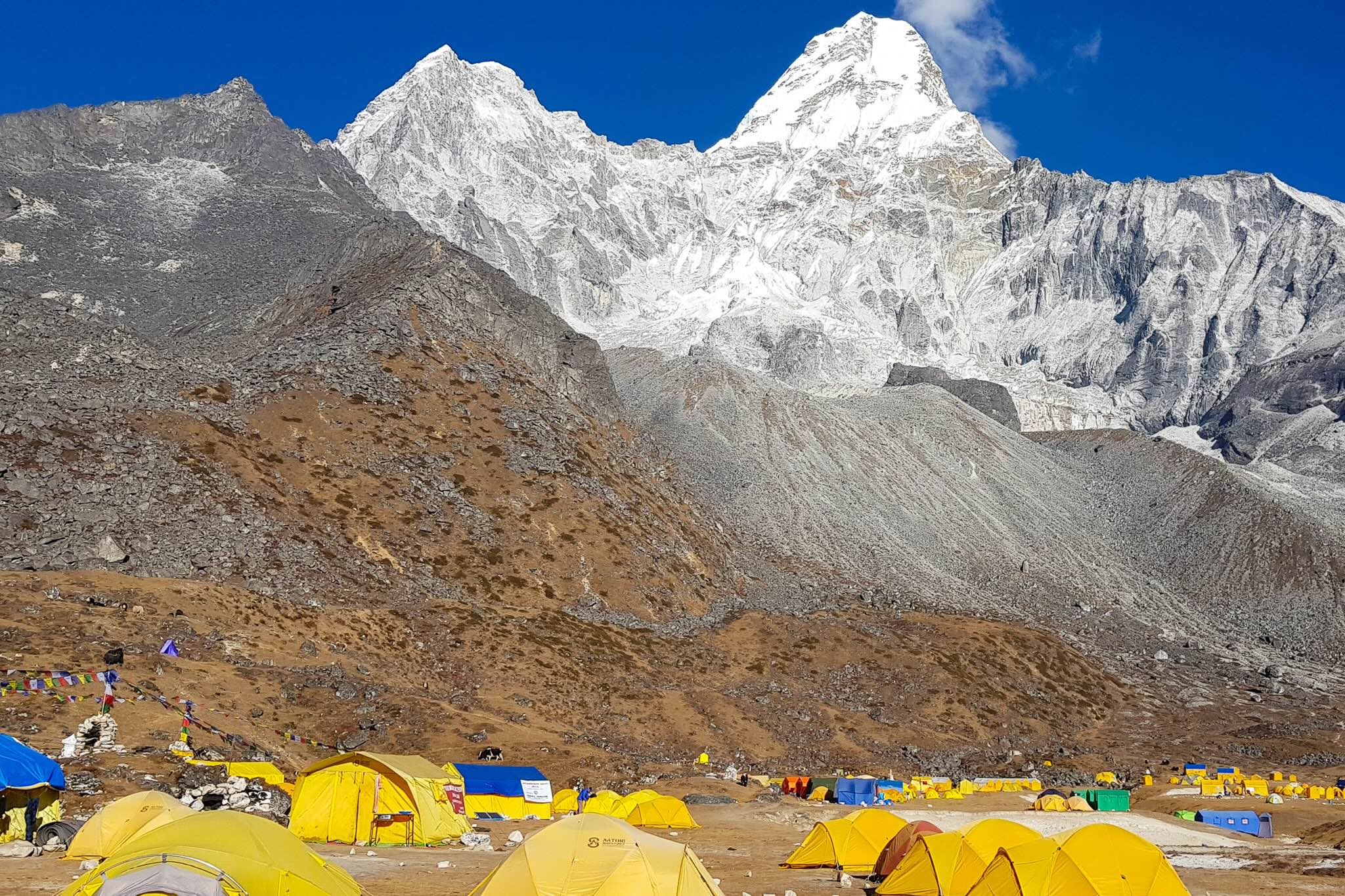
To reach the Ama Dablam base camp, there are several trekking routes. The main trekking route, which most mountaineers take, starts from Lukla and passes through Namche Bazaar and Pangboche before reaching the base camp. But there are alternative approach routes to the base camp.
Then, once on the mountain, the question of going via two or three high-altitude camps arises. Camp 1 and especially Camp 2, set up on the rocky south-west ridge, are well sheltered from objective hazards and avalanches. Camp 3, located at the end of the south-west ridge, lies at the foot of the snowy face that leads to the summit.
Nicknamed the "mountaineers' mountain", Ama Dablam represents a demanding technical challenge. The first major obstacle is the climb to Camp 2. The final section towards the summit includes snow and ice slopes inclined at 55 to 65 degrees.
The ascent of Ama Dablam in full detail
The classic route to reach the summit of Ama Dablam features three high-altitude camps:
- From base camp to Camp 1 (5900 metres), the route towards Camp 1 crosses a zone of rocky blocks and an exposed ridge, generally dry in autumn.
- From Camp 1 to Camp 2 (6100 metres), the route passes via the famous "Yellow Tower", an exceptional piece of climbing.
- For Camp 3, the aim is to reach the Mushroom Ridge, probably the most impressive part of the route. Then comes the summit ascent at 6812 metres, with progress up slopes inclined at between 55 and 65 degrees. The ascent itself represents only half the journey. It is then essential to descend as low as possible to spend the night.
© Bruno Serraz
Mountaineering skills for Ama Dablam and success rate
Technical, physical, mental and hygiene skills are essential for climbing Ama Dablam, as for any great summit.
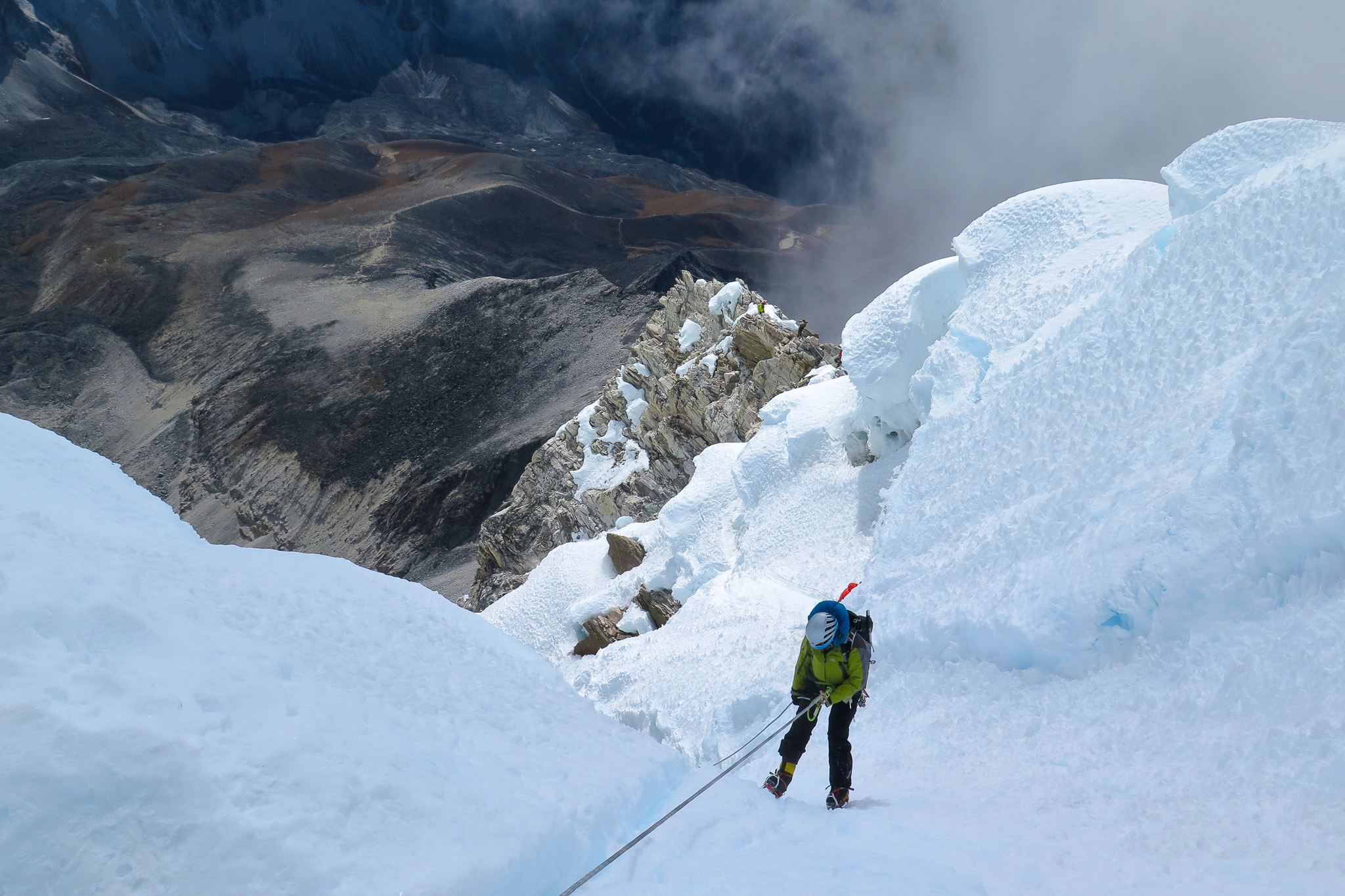
The correct use of fixed ropes and mastery of abseiling techniques on exposed terrain are crucial to minimise risks and reduce the difficulty. In addition, prior experience at high altitude between 4000 and 6000 metres is required.
Excellent physical fitness is essential to face the challenges of the ascent. Training should focus on endurance, core strengthening and weight training in order to improve resistance and stability.
Social isolation before the summit and the maintenance of rigorous hygiene are essential to preserve your well-being and that of your companions.
The overall success rate of ascents on Ama Dablam is estimated at between 60 and 75%, depending on the season and weather conditions.
