
 Expeditions Unlimited blog
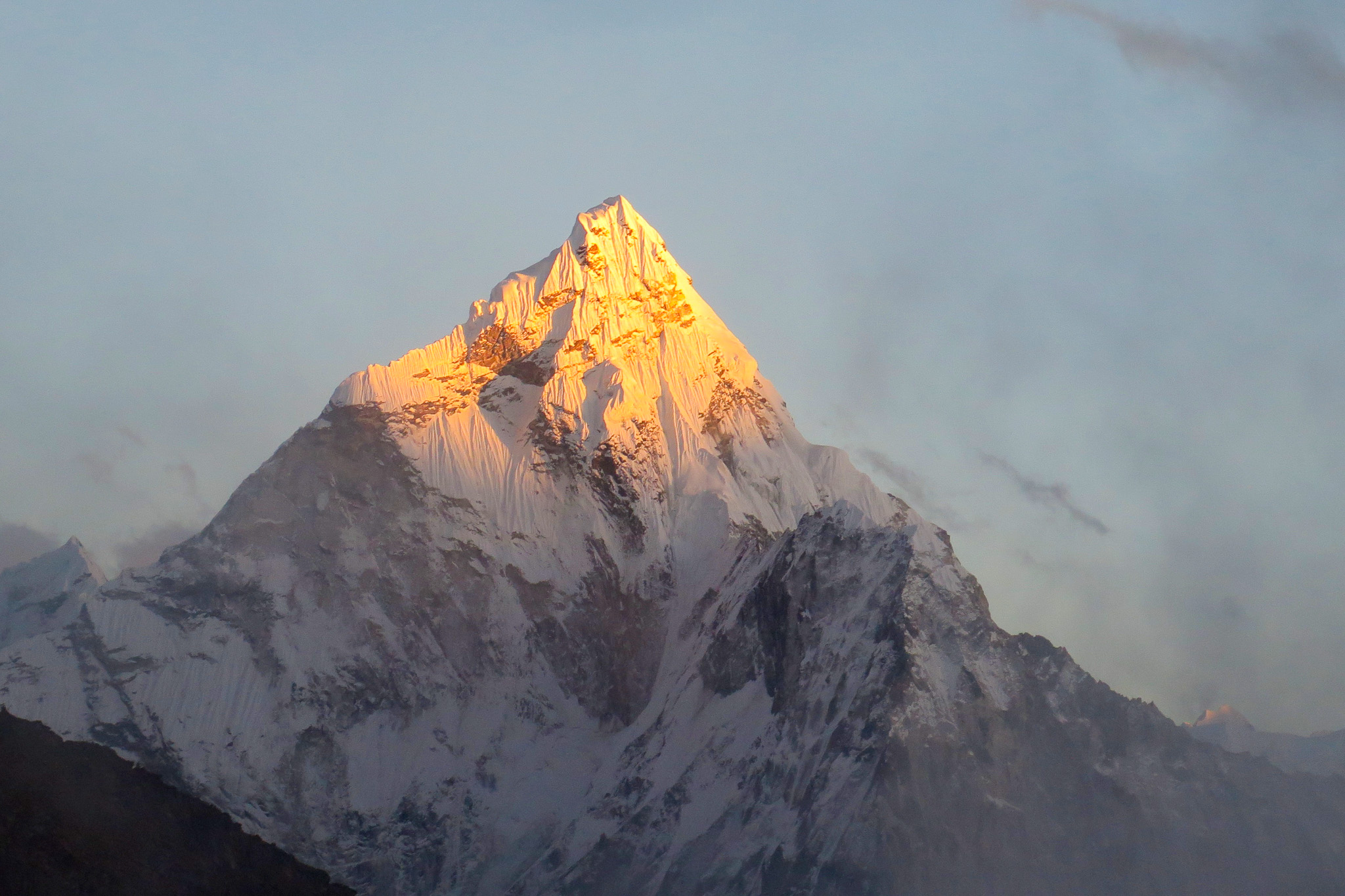
As part of our feature on Ama Dablam, the iconic mountain peaking at 6812 metres in Nepal, in this article we look at the history of this summit and of its first ascent by the no less iconic Sir Edmund Hillary, co-conqueror of Everest in 1953. For it is unthinkable to undertake such an ascent, to throw so much technical and physical strength into the battle, without this light baggage of mountaineering culture.
Once you have chosen the climbing period and carried out meticulous physical and mental preparation, you have just landed in Kathmandu... The ascent of Ama Dablam begins with a classic trek from Lukla.
First ascent of Ama Dablam at the instigation of Sir Edmund Hillary
Taweche (6542 m), Thamserku (6608 m), Kang Tega (6782 m) and finally Ama Dablam (6812 m) rise at the entrance to the upper Khumbu. From the early fifties, during the first exploration of the Khumbu by the British explorer Bill Tilman, several roped parties approached the mountain, already with the idea of climbing it in mind.
First attempt in 1958
In October 1958, an Italo-British expedition launched a first serious attempt by the south-west ridge. At 6100 metres above sea level, they gave up on account of the excessive technical difficulties.
A British group narrowly misses success in 1960
In May 1960, tragedy struck the British group led by J. H. Emlyn Jones just as it seemed set to achieve the first ascent of Ama Dablam, this time by the north-east ridge. The group had climbed the most difficult part of the ridge, largely thanks to the efforts of Michael J. Harris and George J. Fraser. On 21 May, the two men left their high-altitude camp located at around 6400 metres and crossed an imposing ice tower. Their companions saw them heading towards the easier slopes of the summit. No one would ever see them again.
Hillary hunts the yeti
During the winter of 1960–1961, a strong team, led by Sir Edmund Hillary, the co-conqueror of Everest, undertook a scientific expedition to explore the upper Khumbu. The official aim was to set off in search of the improbable yeti, the "abominable snowman", and to study how the human body can adapt to high altitude in winter. After the success on Everest in 1953, public interest in the Himalayas was waning. What better than a yeti hunt to revive interest? Of the yeti, they would find only presumed scalps.
In his book High in the Thin Cold Air, Edmund Hillary describes this yeti hunt and this spectacular ascent carried out at the end of the winter of 1961, despite the freezing cold. On 28 October, after climbing up the Rolwaling Himal valley, the expedition crossed the Trashi Lapsha pass (5755 m) to arrive at the Thame monastery in the upper Khumbu. They then headed towards the foot of the Mingbo La, where they spent several weeks observing the effects of altitude. In mid-February, they were at the foot of Ama Dablam.
© Bruno Serraz
Hillary misses the yeti but brings home victory
The mountaineers set up four camps in succession, overcoming major obstacles, including two vertical steps requiring the use of numerous pitons and rope ladders. The most difficult section, below the Yellow Tower, is rated grade V. Despite extreme conditions and constant exhaustion due to the altitude, the team progressed methodically, establishing a final camp at more than 6000 metres. Four camps later, only the summit slope remained to be climbed. On 13 March 1961, Barry Chapman Bishop (USA), Michael Gill (NZ), Wally Romanes (NZ) and Michael Phelps Ward (UK) reached the summit of Ama Dablam, after following the south-west ridge, which has now become the classic route. The descent should have gone without incident. But below Camp 2, they found the Sherpa Gumi Dorje with a broken leg, the victim of a falling rock. An epic rescue ensued. Although not planned at the outset, this first ascent of Ama Dablam, carried out in winter by the team led by Edmund Hillary, was the crowning achievement of this exploration.
© Bruno Serraz
