
 Expeditions Unlimited blog
Climbing Kilimanjaro in Tanzania always involves a higher budget than it might first appear. International flights, daily park fees, a large local team due to the necessity of carrying everything by porters (tents, collective and individual equipment), the mandatory presence of a licensed guide, tips for this large team... All of this contributes to making the project quite costly, even if this high-altitude ascent remains the least expensive of the Seven Summits, for example.
In addition to everything you need to know to prepare for and complete your Kilimanjaro ascent, here are some budgetary elements to help you plan your finances!
What does it cost to get to Kilimanjaro
© Myriam Roubinet
Which airport ?
Two international airports in Tanzania serve as gateways to Kilimanjaro. Arusha airport at the foot of Mount Meru, and Kilimanjaro International Airport near the town of Moshi. The main French operators favour the latter for their clients, but if you wish to organise the trip yourself, take the time to compare the respective airfares.
Return flight Paris/Lyon/Geneva – Arusha or Kilimanjaro Airport
The price of the flight depends on several factors :
- airline and routing: direct flights and flights with stopovers;
- high or low season. Read our article on when to go;
- day of departure during the week, which is very unpredictable: a Wednesday departure may be cheaper than a Saturday, but not always;
- booking date: here again, contrary to popular belief, the earliest is not necessarily the cheapest, but booking too late can be even more expensive.
In general, expect to pay anywhere from €950 in the best case to over €1500.
Ground transport
© Jérôme Brisebourg
Arusha is located at the foot of Mount Meru, whose ascent can serve as acclimatisation before climbing Kilimanjaro. It is situated 80 kilometers from the town of Moshi, itself at the foot of Kilimanjaro. Most local agencies organising the ascent are based in Moshi.
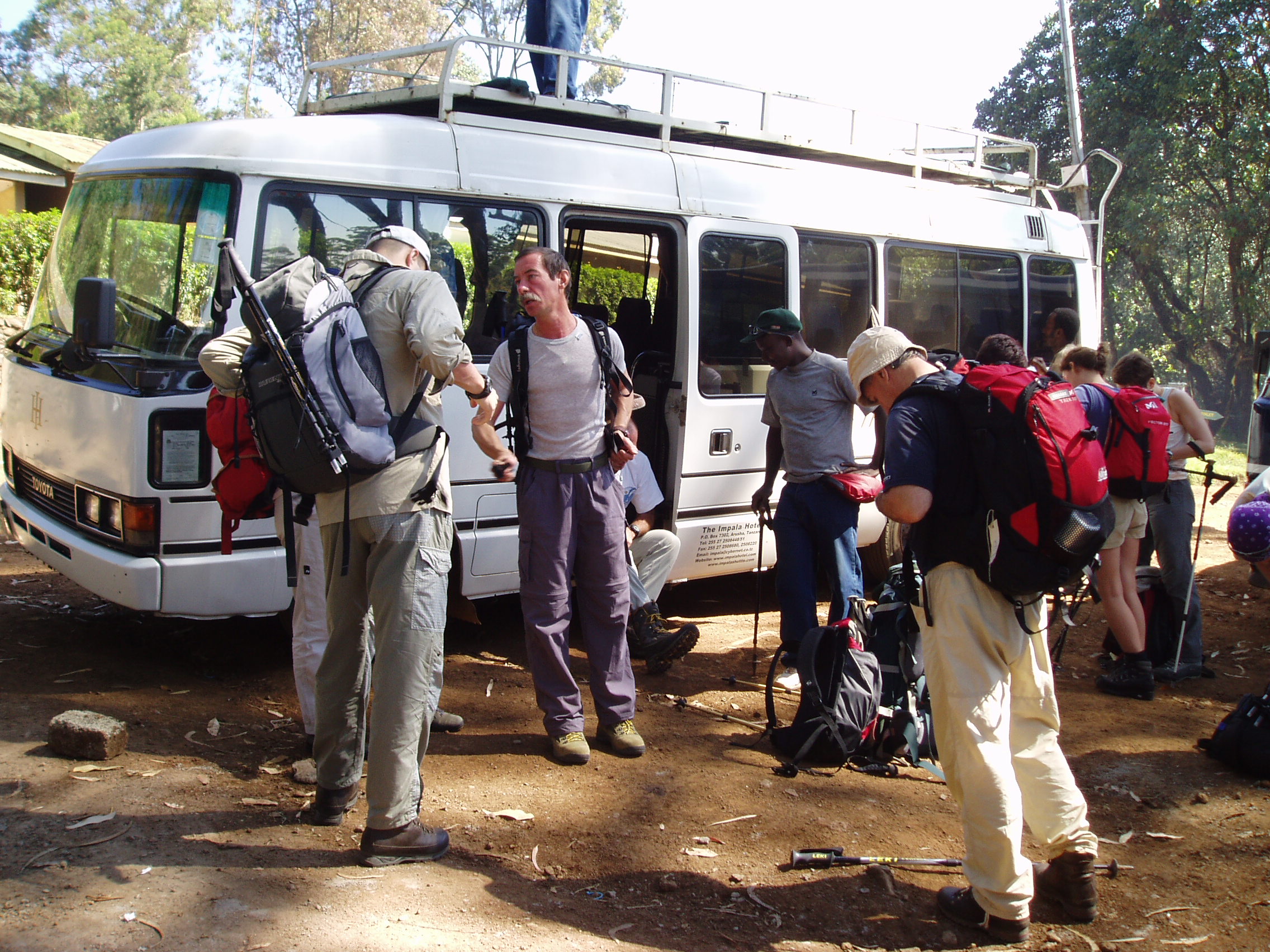
If you land in Arusha, you will need to arrange ground transport by bus to reach Moshi. It is also possible to travel by train or even on a domestic flight, but neither offers any value for money.
Cost of a bus transfer: between 3 and 5 US$ for a 1 hour 30 minute journey. The main international operators arrange private transfers for their clients between Kilimanjaro Airport and Moshi. Individuals can book these services themselves for €100 to €150 return.
Most hotels also offer these services for a fee. Allow 2 to 3 hours between Kilimanjaro Airport and Moshi.
Kilimanjaro ascent logistics with an operator
© Jérôme Brisebourg
Of the five main ascent routes on Kilimanjaro, international operators offer a selection of routes they consider most attractive to simplify the choice for their clients. As an example, Expeditions Unlimited limits its standard offering to the following three itineraries, generally for small groups:
- Machame route over 7 days via the south-west then south face, from 2 to 12 participants;
- Rongai route over 7 days via the north face, from 4 to 6 participants;
- Great Crossing route over 9 days across the west, north, east and then south faces, from 4 to 6 participants.
The many local operators offer seven to eight routes as standard, with groups ranging from a few people to more than 16 participants, and prices vary from the most serious to the least serious.
As an example, the express Marangu route over 5 days can be offered at 1500 US$ per participant with minimal service and without accommodation. One to avoid in our view. The price of the Machame route over 7 days currently runs at around 2000 US$ per participant when purchased locally.
Prices are justified by often very large local teams: assistant guides, licensed guides, cooks and assistant cooks, porters for collective equipment, individual equipment, water, and even a porter for... the portable toilets, etc.
Tips are never included, so minimum amounts are always specified before departure to avoid any ambiguity. See end of document.
Any particularly low budget either involves hidden costs or trade-offs that compromise safety: lower quality guiding, fewer acclimatisation days, reduced equipment comfort and food quality, etc.
Tips
The question of tips on Kilimanjaro was long a real headache. The regulations put in place in 1991 also helped to resolve a situation that was often contentious at the end of the trek.
For reference, here is what it is customary to leave for the team :
- min. 85 US$ / guide
- min. 45 US$ / porteur
- min. 65 US$ / cuisinier
In total, depending on the size of the team and the size of the group, you should generally allow between 200 and 400 US$ per participant, to be paid in US dollars. A portion can also be paid in euros.
Official rates on Kilimanjaro
The official fee, set by the park authorities, is US$70 per trekker per day spent within the park boundaries.
Organising the climb on your own ?
© Expeditions Unlimited
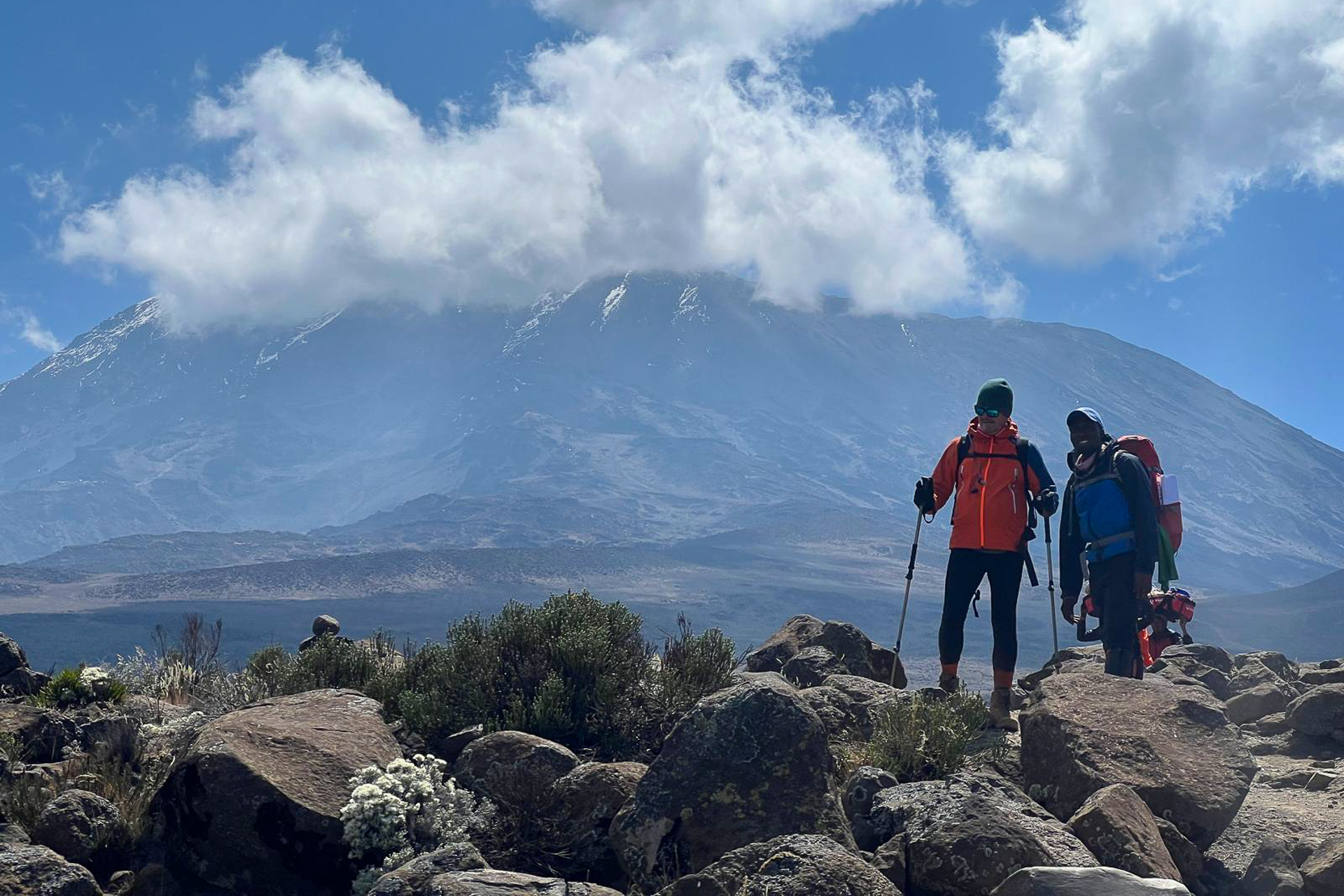
Personal challenge, quest for authenticity, these are just some of the good reasons for wanting to tackle Kilimanjaro on your own terms.
For some, completing the trek and ascent of Kilimanjaro with a full team of guides, porters and cooks simply does not feel right. The summit must be "earned", and for that, it is good to endure a few hardships and forgo the excessive comfort offered by a full support team.
Others are simply looking to save money. A Kilimanjaro expedition is expensive, particularly due to park entry fees and staff wages. Reducing the number of accompanying personnel seems like a solution to lighten the bill.
Since 1991, climbing Kilimanjaro without a licensed guide has been prohibited
Since 1991, it has been mandatory to be accompanied by a licensed guide to undertake the ascent of Kilimanjaro. The guide must be affiliated with a licensed tour operator, as only these agencies can purchase park permits.
Attempting to climb Kilimanjaro without a guide is very risky:
- rangers and local guides maintain strict surveillance;
- severe penalties apply: fines, expulsion or local imprisonment;
- you can be almost certain of being spotted and stopped.
Kilimanjaro, a mountain without water
Although the mountain's slopes are covered with glaciers (even if these have shrunk considerably over the past twenty years), few streams run down the flanks, as water is immediately absorbed by the volcanic terrain and its many fissures. As a result:
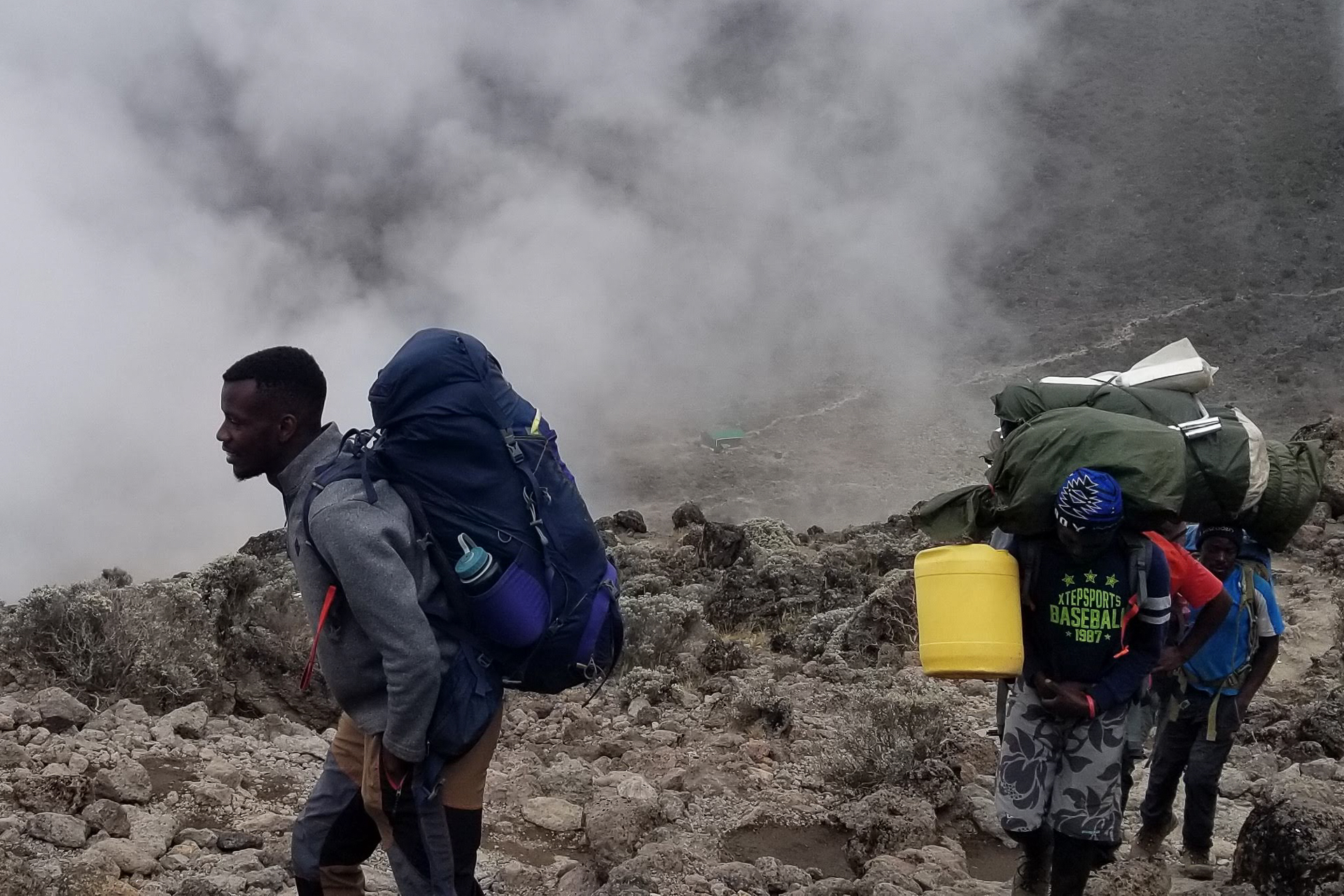
- at altitude, porters make several return trips to fetch water;
- above 4000 meters, there are no reliable water sources;
- without porters, you would need to carry litres of water yourself, making the ascent unmanageable.
In short, without assistance, the weight of the pack would exceed 30 kg, an enormous burden on the most difficult sections.
Porter or no porter ?
© Jérôme Brisebourg
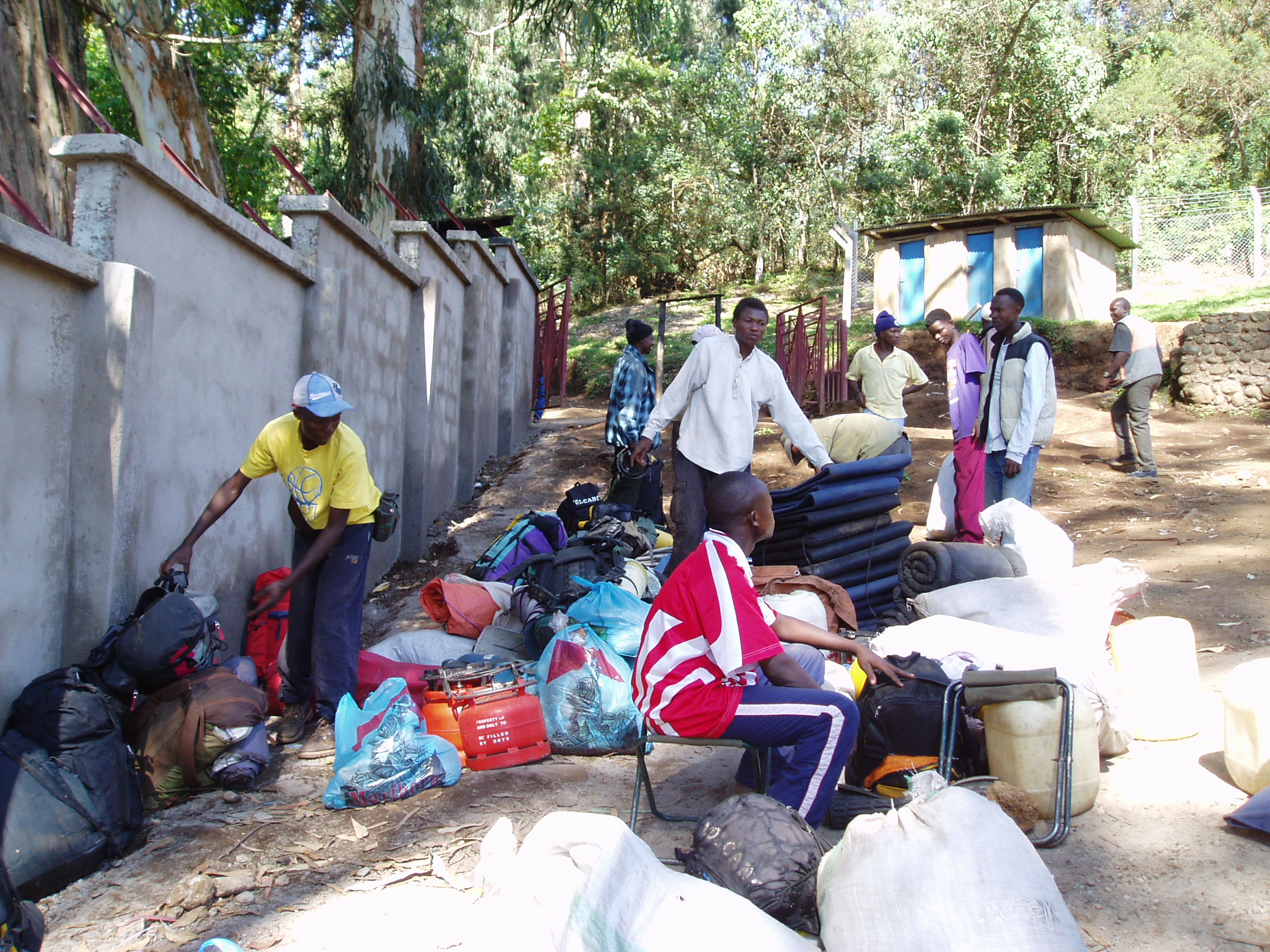
Can you climb Kilimanjaro without porters? Technically, yes. The law only requires the presence of a licensed guide, but not porters. In practice, it is virtually impossible.
The guide himself will insist on porters. He will not want to carry tents, food, a stove and fuel on top of his own equipment.
Why accept the help of guides and porters?
© Myriam Roubinet
Attempting the ascent without assistance is dangerous, exhausting and unrealistic. Guides and porters are not there to pamper you, but to ensure your safety and make the experience more enjoyable. Accepting their help allows you to:
- fully enjoy the trek without worrying about logistics;
- improve your safety and your chances of reaching the summit;
- support the local economy and those who depend on it.
So make peace with the idea: let yourself be guided and savour this unique experience on Kilimanjaro!