
 Expeditions Unlimited blog
To choose your ascent route on Kilimanjaro (5895 m), there is nothing like comparing the respective elevation gains, route by route. In this article, which is part of our feature on everything you need to know to prepare and carry out your ascent of Kilimanjaro in the best possible conditions, we review the dangers of altitude and the physical effort involved. We compare the various ascent routes and their respective elevation gains so that you can make your choice with full knowledge of the facts. Finally, we examine a very tempting proposal of a night at the summit of Kilimanjaro, and the reasons that lead us no longer to consider such a project.
In summary, the ascent of Kilimanjaro presents two particularities that have a massive impact on physiology:
- a very rapid gain in altitude
-
a steep temperature gradient.
Moreover, many trekkers who are little accustomed to travelling at high altitude set off on the slopes of Kilimanjaro. They must be all the more vigilant.
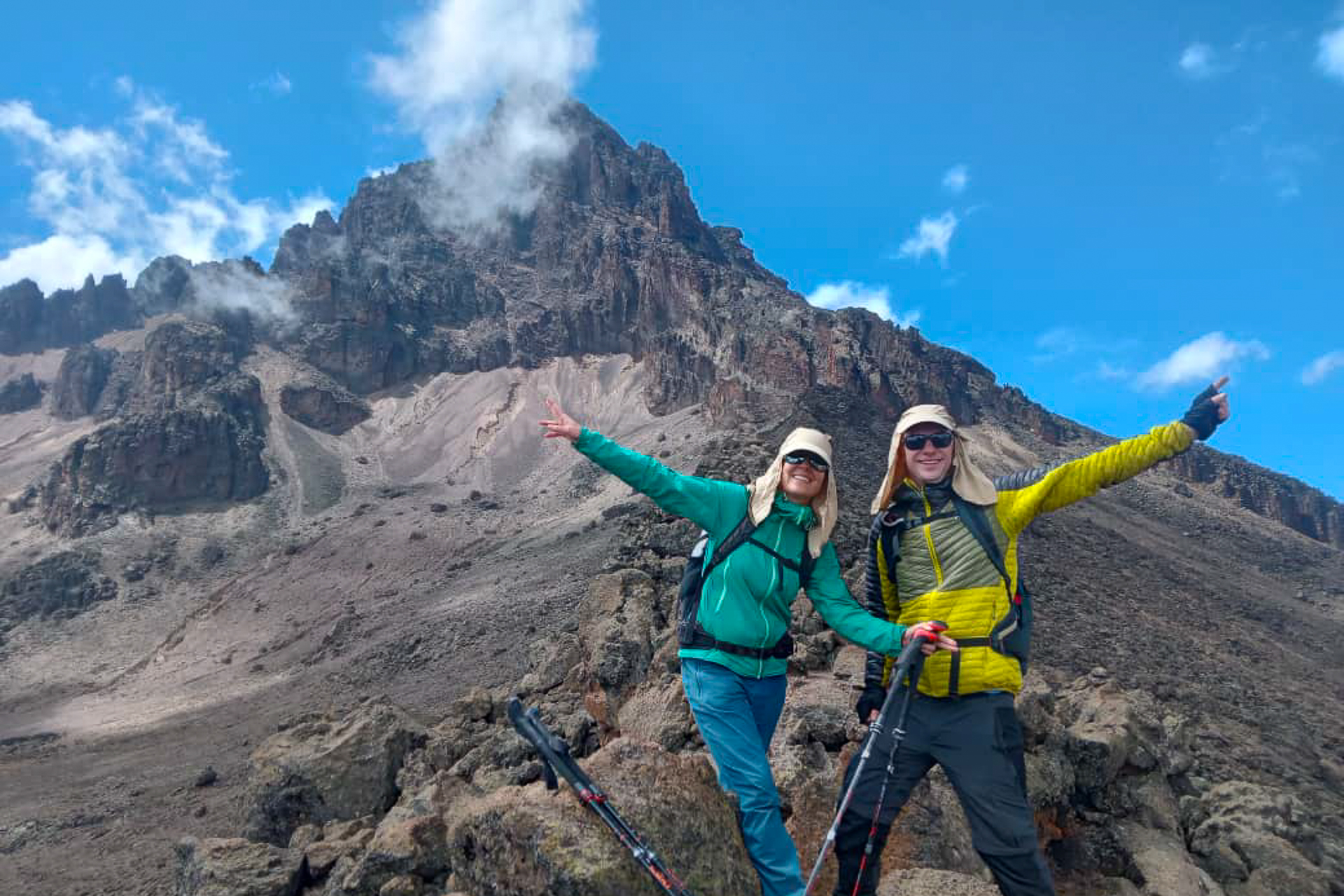
Kilimanjaro, a high-altitude summit
© Expeditions Unlimited
The dangers of altitude
These factors combine to increase the risk of triggering the symptoms of AMS (Acute Mountain Sickness). In all our descriptive sheets, you will find comprehensive advice on the issue of altitude, written in partnership with IFREMMONT (Institute for Training and Research in Mountain Medicine) in Chamonix.
Here we will keep only this short extract: :
"When trekking, 500 to 800 metres (of elevation gain) per consecutive night is recommended up to 3,000 metres, then between 300 and 500 metres maximum beyond that."
Comparison of elevation gains on the Kilimanjaro ascent
As an example, here are the elevation gains encountered on Kilimanjaro, on the shortest route, the Marangu route (also known as the Coca-Cola route), which we do not offer:
That is an average elevation gain of nearly 950 metres between each consecutive night, up to the last one before the summit.
Here, by contrast, is the comparison of the three routes we recommend:
The Machame over 7 days
Claude a répondu : That is an average elevation gain of nearly 570 metres between each consecutive night, up to the last one before the summit.
That is an average elevation gain of nearly 570 metres between each consecutive night, up to the last one before the summit.
The Rongai over 7 days, with an acclimatisation day at Mawenzi Tarn
That is an average elevation gain of nearly 530 metres between each consecutive night, up to the last one before the summit.
The Great Kilimanjaro Traverse over 9 days
As you will be able to see, the Great Kilimanjaro Traverse optimises the daily elevation gains and makes this route the one that gives the best chances of success in comfortable conditions.
That is less than 400 metres of average elevation gain between each consecutive night, up to the last one before the summit.
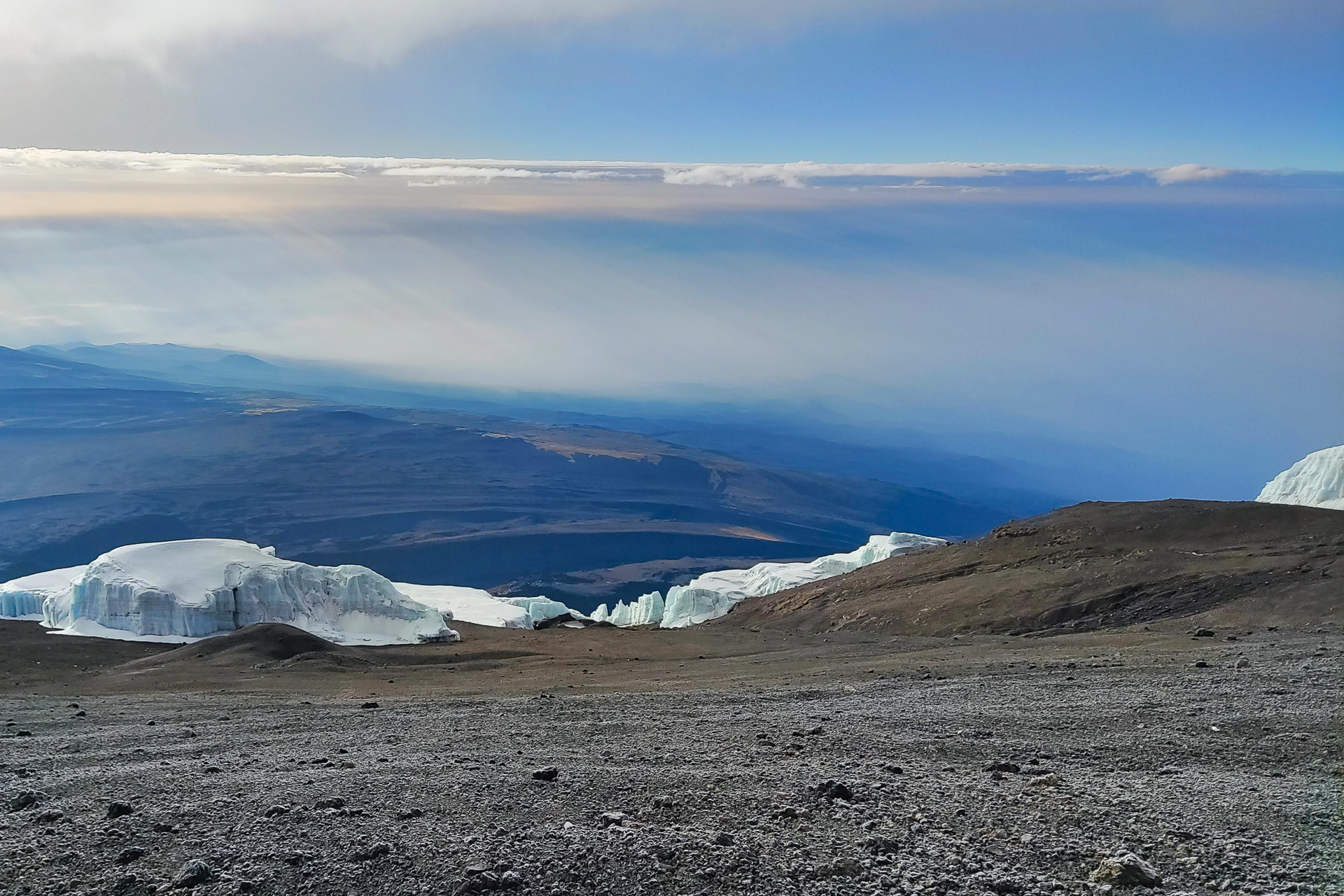
Sleeping at the summit of Kilimanjaro at 5895 metres
© Expeditions Unlimited
The idea of sleeping at the summit of Kilimanjaro, or even in the caldera, may seem appealing. It is certainly an extraordinary experience. However, it runs into a number of difficulties that dissuade us from launching the adventure.
Too rapid a gain in altitude
The previous tables show that the gain in altitude is abnormally rapid. Since one stays only a short time at the summit (Uhuru Peak) in order to descend the same day to an altitude that is reasonable for the body, few participants encounter real altitude-related problems. Sleeping at the summit means a night at almost six thousand metres, with markedly insufficient acclimatisation. How can you descend quickly and safely if one or more participants happen to fall victim to AMS during the bivouac?
Climatic conditions that are too variable and change suddenly
As we illustrated in our article on the best seasons to attempt Kili, the weather conditions on Kilimanjaro are highly unstable. The bivouac may well begin under a clear sky and end in a storm.
High logistical costs for a small number of participants
Where there is a bivouac, there are tents to carry and shared equipment to carry. The local teams will not agree to climb the final stage of the ascent with such loads. We will address this topic in the budget section of this feature on Kilimanjaro.
The adventure would be worth attempting by individuals who are self-sufficient in carrying their own equipment.
Park authorisation
There is no guarantee that the park authorities will agree to grant the authorisation needed for this project.