
 Expeditions Unlimited blog
This season, we are shining a light on three of the most committed expeditions around the Arctic rim: the crossing of Greenland from west to east, that is 550 km across the ice sheet; the Northwest Passage, 400 km over the sea ice of the Canadian Arctic, in the wake of Amundsen; and the full crossing of Spitsbergen, from south to north, 600 km between 76° and 80° of north latitude. Three worlds that seem alike at first glance, yet are very different. Sébastien Royer, our Polar Regions area manager and guide, knows them from the inside: he sets out what truly distinguishes each of these great polar crossings.
At Expeditions Unlimited, the great polar crossings form the family of "level 3" expeditions. They are characterised by complete self-sufficiency over very long distances and by durations ranging from 28 to 35 days, with temperatures that can reach -40 °C… In short, adventure as we conceive it!
On paper, they all resemble one another. In the field, each has its own "personality". Sébastien Royer, our Polar Regions area manager, guide and great connoisseur of the Arctic, has travelled its glaciers, sea ice and ice caps. He looks back at what distinguishes our three largest expeditions.
The crossing of Greenland from west to east: the ice sheet
© Sébastien Royer
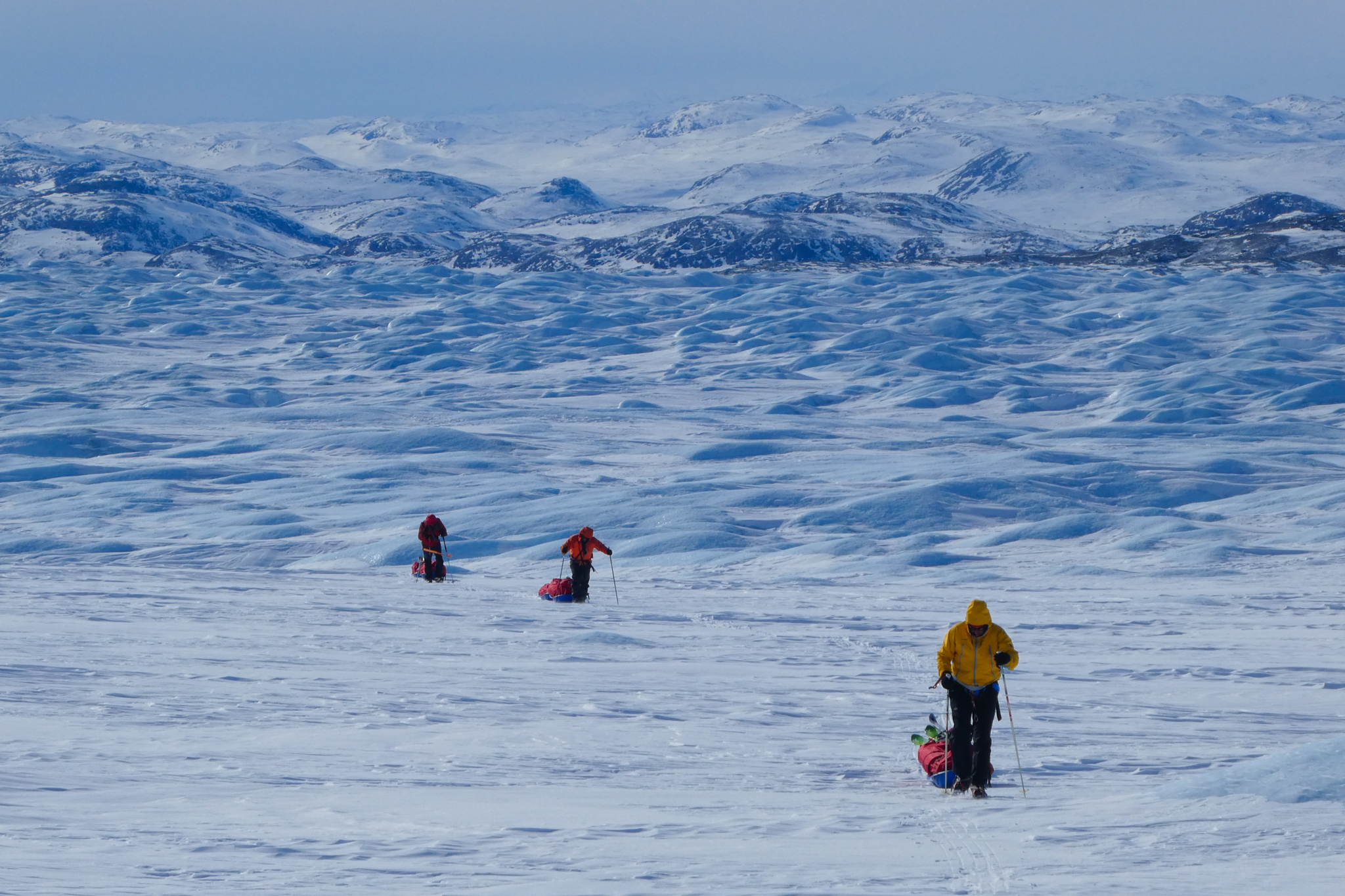
This is the most iconic crossing: from one coast to the other, from the Baffin Sea to the Greenland Sea. Access is fairly easy in the west-east direction, as we reach the airport of Kangerlussuaq, well served from Copenhagen. We keep a stock of equipment near the airport, as well as a well-organised base camp to prepare our gear and distribute a month's worth of self-sufficiency across the pulkas. A 50 km transfer takes us into the moraine, to "point 660", at the foot of the glaciers that descend from the ice cap.
The most demanding effort is concentrated in the first three days: we have to haul our 70 kg pulkas uphill, through the twists and turns of the glaciers, in order to gain altitude and reach the ice sheet. Crampons are often necessary to progress over the frozen rivers, in an incredible bluish world.
From the fourth day, the terrain becomes gentler and the climb continues steadily up to the former American radar base DYE-2, at 2,150 m of altitude. Discovering this base, a genuine relic of the Cold War, is an absolutely fascinating objective.
A certain discipline sets in, with 20 to 25 km to cover daily. We generally set off at the end of April to reach the other side at the end of May. We travel at a relatively low latitude and, even if temperatures can be cold at the start, they rise fairly quickly over the course of the expedition. The surface then becomes nicely slippery for our pulkas, while temperatures under the tent are particularly pleasant when the sun is shining.
From the east coast, at the end of 28 to 30 days of crossing, we reach Tasiilaq by helicopter, before taking a flight to Iceland.
To sum up, the challenge of this crossing lies above all in mental endurance, even more than in physical effort. It is of course essential to have a perfect command of bivouac-management techniques: pitching and protecting the tent, using the stove… and to have tested the whole of your personal equipment: ski boots, gloves, and so on.
Since 2017, Expeditions Unlimited has been the only French-speaking organisation to offer this expedition.
The Northwest Passage: on the sea ice and in Amundsen's footsteps
© Sébastien Royer
The Canadian Arctic has one particular feature compared with Greenland: the cold!
Indeed, despite a latitude slightly further north than that of the Greenland crossing, Nunavut does not benefit from the influence of the Gulf Stream. The temperatures encountered in April are often close to –30 °C.
These are exactly the temperatures we encountered during the 2026 edition of this expedition, over the 400 km and 21 days of crossing between the Inuit communities of Cambridge Bay and Gjoa Haven. When the wind joins in, the felt temperatures drop below -40 °C.
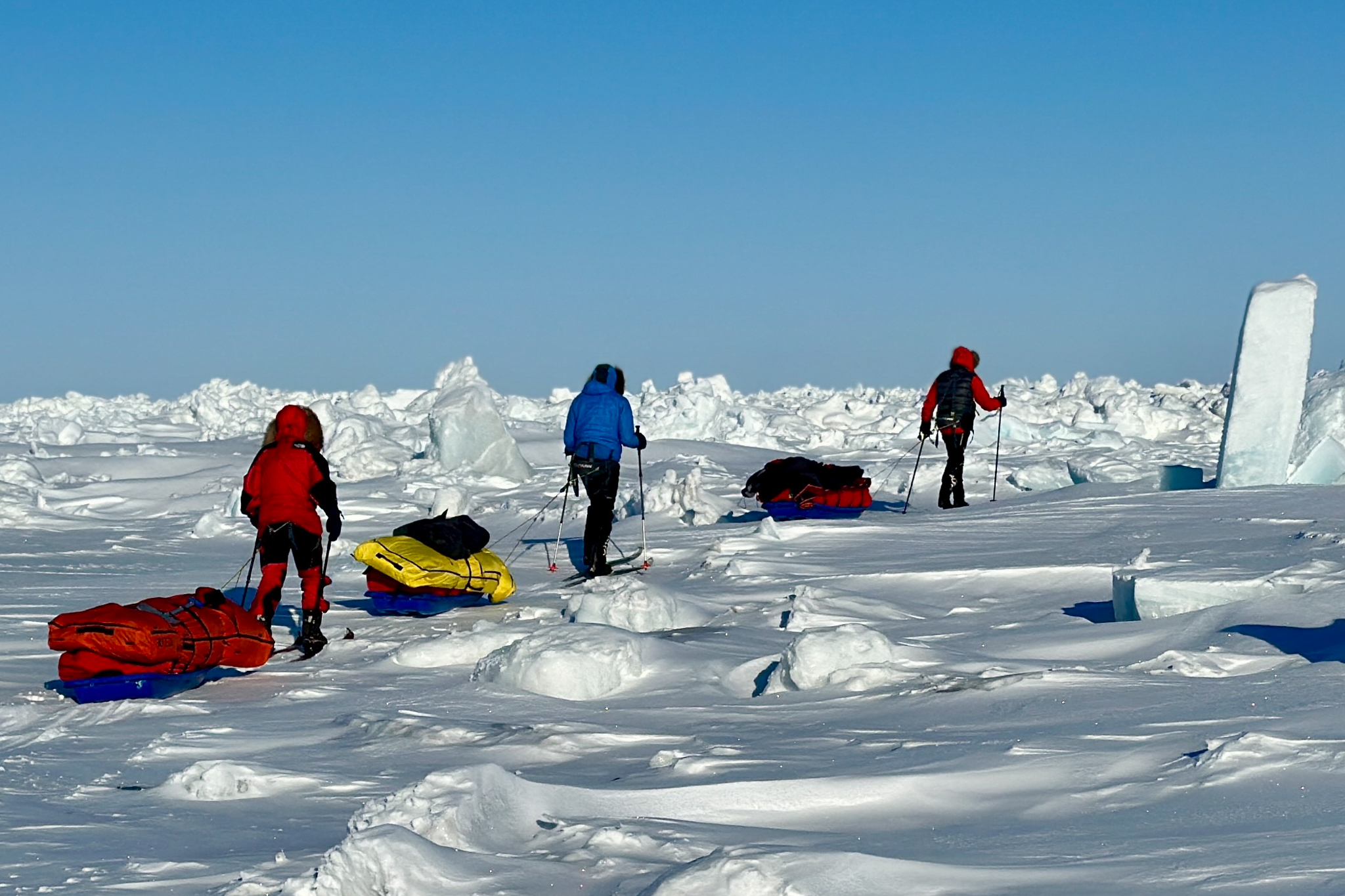
The second challenge we have to face is the terrain: two thirds of the route follow the sea ice, good and solid at this time of year, but rarely as flat as one might imagine. Accumulations of snow on the surface form "sastrugi", blades of hard snow that have to be negotiated.
Halfway along, once Jenny Island is behind us, the sea ice is subject to a strong current from the north. We then have to make our way through a fantastic chaos of ice, which must be read carefully in order to find a passage. Getting through this zone calls for real physical commitment to bring our pulkas across.
Where there is sea ice, there is polar bear habitat! It is possible to come across them during the expedition. These encounters, charged with emotion, require adherence to a very precise protocol, which we have fully mastered.
This expedition sits clearly a notch above the Greenland crossing in terms of commitment, and few people have taken up this challenge. It is clearly adventure as we love it at Expeditions Unlimited!
We prepare you specifically for this expedition, in particular thanks to a very precise equipment list suited to the conditions encountered.
Since 2024, Expeditions Unlimited has been the only French-speaking organisation to offer this expedition.
The crossing of Spitsbergen from south to north: the most varied
© Sébastien Royer
It is hard to go further north than Spitsbergen, short of reaching the North Pole.
This expedition is today the ultimate challenge of our range, with more than 600 km to cover to link the southern tip of the island of Spitsbergen to its northern tip, in 32 to 35 days.
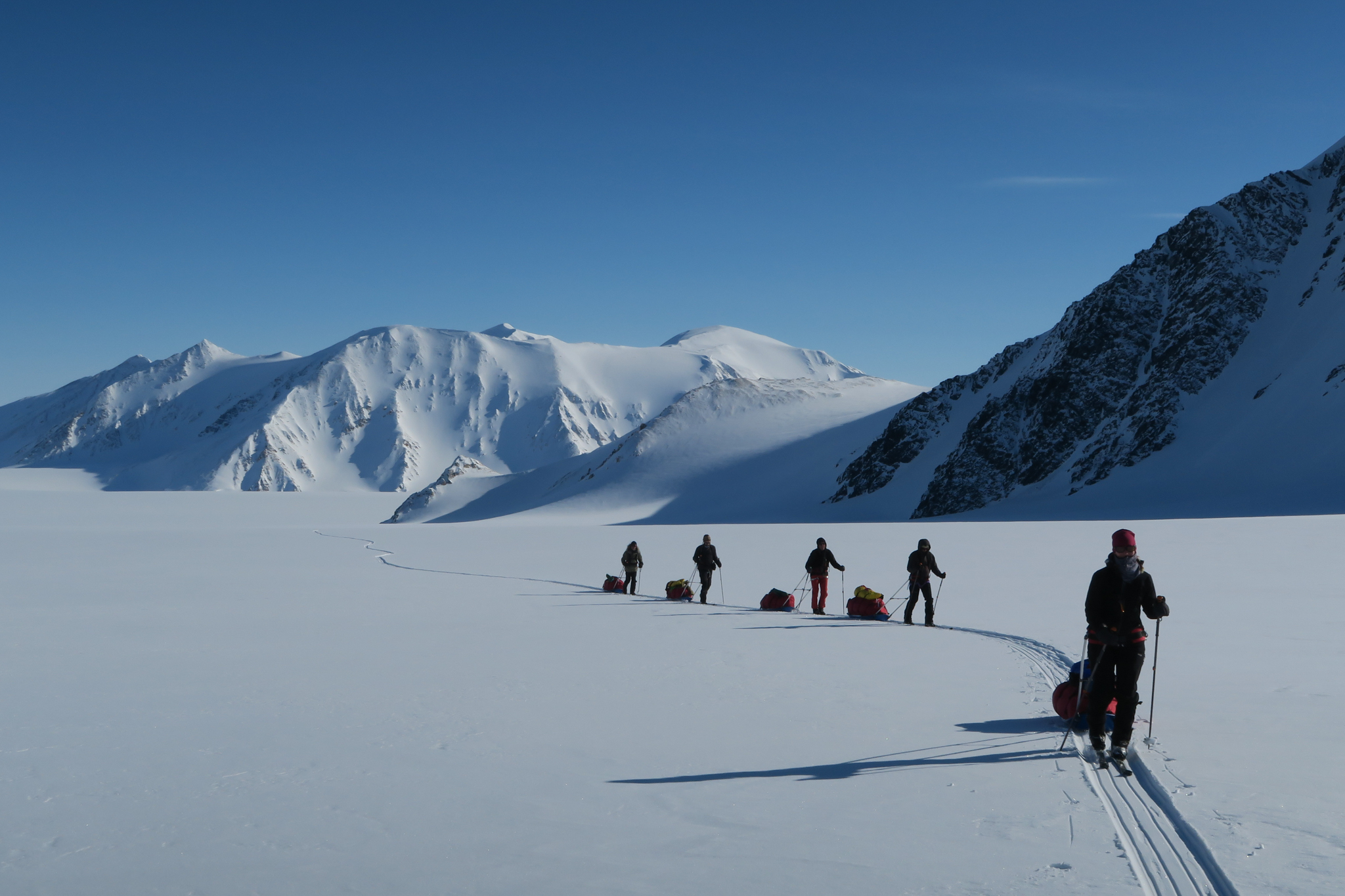
Here, a further component is added to the distance: the elevation gain. We cross the island essentially by way of the glaciers and ice caps that cover Spitsbergen, and can accumulate up to 6,000 m of positive elevation gain.
The landscapes we cross are very varied and particularly striking, from mountains to ice caps by way of the sea ice.
As for temperatures, as in Greenland, they can come close to -30 °C, then rise quickly at the end of the expedition with the arrival of spring.
Finally, here more than anywhere, polar bears are numerous and the probability of encountering one is high, which raises the level of the adventure by a further notch!
This expedition sits clearly at the highest level of commitment and adventure in our range. It calls for solid experience of polar raiding as well as unshakeable motivation.
Expeditions Unlimited is the only French-speaking organisation to offer this expedition.
As you will have gathered, these demanding expeditions require serious preparation.
For this, we offer a whole range of progression trips, starting with the polar-expedition preparation course in the Jura and passing through the level 1 expeditions (Finland and Spitsbergen) and level 2 (Greenland) to arrive at the level 3 expeditions: the great crossings.
Call us right now and we will design the route 100% suited to your dreams of adventure!

Crossing Greenland from West to East

Northwest Passage crossing ski manhauling in the Canadian Arctic
