
 Expeditions Unlimited blog
Having reached six of the fourteen 8000 meter summits on our planet and passionately lived through 40 years of mountaineering history, Bernard Muller leads several of our mountaineering courses at the École de l'Aventure in the Alps as well as ascents above 7000 meters: Mustagh Ata, Pic Lenin, Himlung Himal next October and the Everest ascent in spring 2021. In a video interview, he answers our questions about his career and high-altitude expeditions.
The call of the mountain
It all begins with watching an old film: Les étoiles de midi, a classic of mountain cinema directed by Marcel Ichac. Bernard discovers high mountain terrain through black and white images, this inaccessible world fascinates him. He is around fifteen years old at the time, living in Strasbourg where mountaineering was not really part of the culture, and no one around him practises it. A year later, he enrols in a climbing school and is slightly disillusioned: he has the feeling of not being particularly gifted... Which does not stop him from going on an expedition to the La Meije glacier (3983 meters) at the age of eighteen. Every summer, he sets himself the goal of pushing his limits — first in the Alps and then eventually in Peru. Bernard has a secret dream of one day climbing the Himalayan mountains... A dream that was practically impossible at the time.
He nonetheless goes on to complete, among many other climbs, the north face of the Dru, the north face of the Grandes Jorasses, the Frêney Pillar, the north face of Les Droites in winter, and the Angle Pillar, etc.
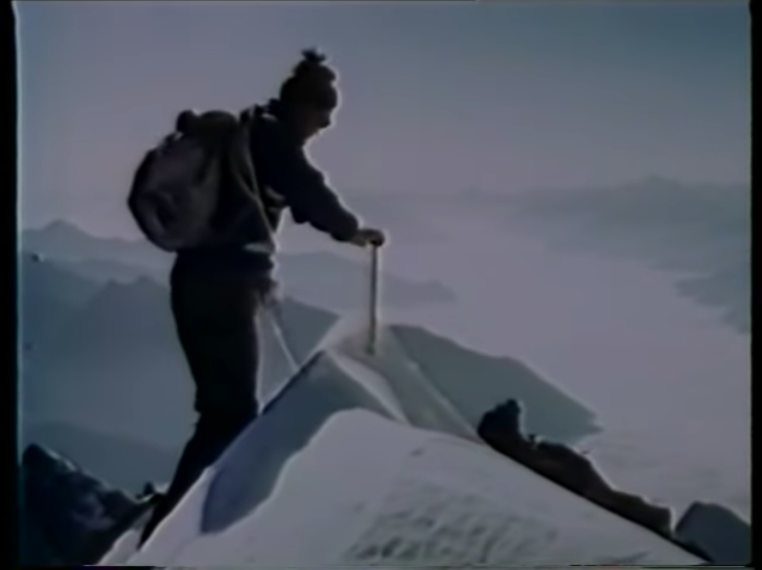
Still from the film Les étoiles de midi
Brushing the summits
In the mid-1970s, he begins tackling international expeditions with friends from the CAF in Grenoble, and in the late 1970s, with Pierre Beghin in the Himalayas. He starts in Peru with the ascent of Perupajá. He then heads to Nanga Parbat on the Mazenot route, as part of a team of 25 people with not always easy group dynamics. Not everything goes as planned, and the ascent ends in failure. He is convinced, like others, that the future of mountaineering lies instead in the lightest possible expeditions: only essential equipment and at most ten people.
He makes an attempt with Pierre Béghin on the south pillar of Dhaulagiri, they get through it but the final summit section proves impossible due to the arrival of the monsoon. Then comes the success of their first 8000 meter peak via the south face of Manaslu, Nepal, a world first in 1981 (8156 meters), followed by Nanga Parbat in Pakistan, Kangchenjunga, Nepal (8505 meters) in 1985, and so on.
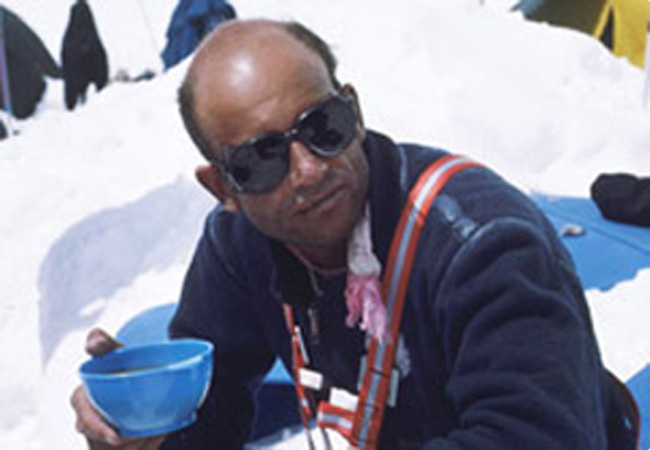
Bernard Muller at the base camp of Gasherbrum II, Pakistan in 1986 © Bernard Muller
First steps as a guide
Quickly, he develops the desire to share his experience by becoming a guide and envisions a first commercial expedition to Gasherbrum II, Pakistan (8035 meters). An initiative criticised by the handful of passionate mountaineers who then reign over the summits and do not wish to share "their" playground with the general public. Although Bernard appreciates solo mountaineering, what thrills him above all else is the human adventure. His mind is made up, he takes on the responsibility of guiding those who wish to reach the roof of the world.
In the rest of the interview, we discuss the role of the guide within an expedition, acclimatisation for reaching an 8000 meter peak, and the ascent of Everest...
Complete a guided ascent with Bernard Muller:
- Ascent of Everest via the Tibetan route (8848 m), departure April 10, 2021: ascending the roof of the world... The dream of a lifetime.
- Ascent of Pic Lenin (7134 m), a first summit above 7000 meters.
- Ascent of Himlung Himal (7126 m), ascending a mythical 7000 meter peak in Nepal.
- Ski ascent of Mustagh Ata (7546 m), a ski ascent of a mythical summit above 7500 meters.

Climb Lenin Peak at 7154 meters in Kyrgyzstan

Climb Himlung Himal at 7126 meters in Nepal
