
 Expeditions Unlimited blog
Altitude is an unavoidable component of our treks and ascents. It is we who choose to move and exert ourselves at altitude, while knowing full well that it does not take kindly to being taken lightly! What can we do to ensure this experience does not become an ordeal, or turn into a disaster? Paulo Grobel, a high mountain guide with vast experience, often off the beaten track, who leads our groups on the ascent of Manaslu (8156 m) among others, shares his perspective on altitude during a truly immersive journey in the course of which we cross together the Larkye Pass, then Samagaon, all the way to Manaslu base camp...
A short story about altitude
While guiding an expedition to Manaslu (8156 m) in spring 2009, Paulo takes stock of the participants' physical condition upon arriving at Bimtang (3590 m). He realises that eight out of ten people are struggling: gastric problems, headaches, neck pain... 80% of the mountaineers in the group, who were nevertheless aiming for an 8000 meter peak, were in poor shape after only one week of trekking, and for good reason: acclimatisation does not begin at base camp, as is widely believed, but well before. It starts from the moment of departure from Kathmandu, or even from France. And above all, it must be very gradual and structured.
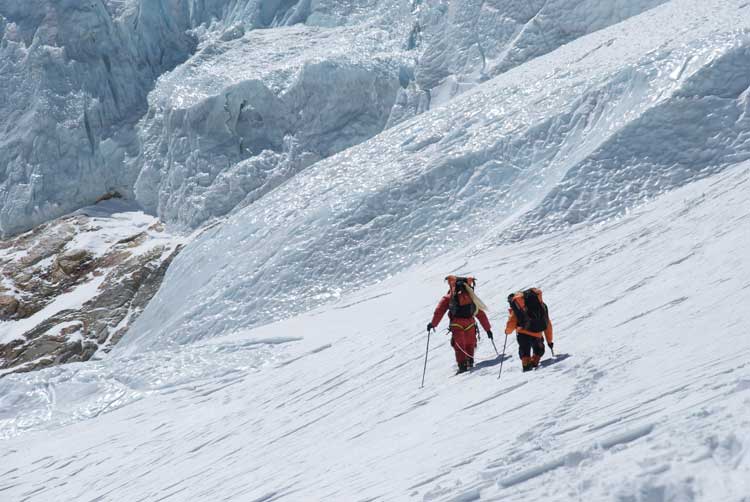
Ascent of Manaslu © Paulo Grobel
The notion of team above all else
During a trek or ascent, participants move in a hypoxic environment (with an oxygen level too low relative to our body's needs) and therefore a potentially dangerous one. Our group is a true social organisation that must make decisions and in which human factors play a role. The leader's stance and the size of the group naturally influence these interactions, the larger the group, the more complex they become; the smaller the group, the fewer the interactions. For Paulo, an ascent is above all a participatory and co-constructed group project, where the involvement of each member is essential to see the project through to the end.
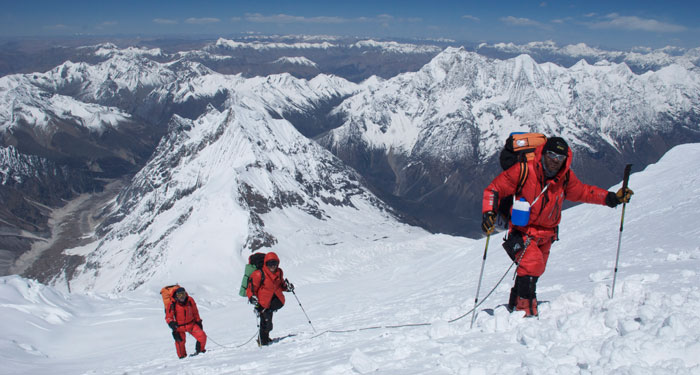
Ascent of Manaslu © Paulo Grobel
Before the trip: the briefing
For any major ascent, a preparatory meeting with all participants is essential. It allows the various members not only to meet one another, but above all to increase their theoretical knowledge of hypoxia and altitude, to learn best practices and to develop an awareness of the reality of the expedition. Paulo draws inspiration from practical nivology for acclimatisation and systematically incorporates briefing and debriefing sessions during each key moment of the trek :
- Kathmandu
- First day of walking
- Arrival at around 3000 meters
- Base camp
- First night at Camp 1
- Load carrying and progression
- Before the pass or the summit
We have just covered a few important points ahead of the trip, in the rest of the interview, we continue our ascent with Paulo towards the Manaslu camp, getting straight to the heart of the matter: arrival in Kathmandu.
Find out more :
- The ascent of Manaslu at 8156 m with Paulo Grobel: a mythical and relatively accessible 8000 meter peak.

Climb Manaslu at 8163 meters in Nepal

Climb Dhaulagiri at 8167 meters in Nepal
