
 Expeditions Unlimited blog
On 12 October 1967, to encourage and reward the country's best mountaineers, the Bureau of the Central Council of Sports Societies and Organisations of the USSR decided to award a prize to those who managed to climb the five highest Soviet summits, at 7000 metres and above. The reward: to become a "Snow Leopard", that mythical animal of Central Asia. In 2011, Serge Hardy became the fifth and last Frenchman to obtain the title. Who will be next? Together with Serge Bazin, Expeditions Unlimited has decided to take up the challenge from 2022 onwards. Setting off regularly for Lenin Peak at 7134 metres, we climbed Korzhenevskaya Peak at 7105 metres in 2023. In summer 2025, we are heading back to Lenin Peak and, in addition, for those who are already seasoned, we are going to attempt the ascent of Khan Tengri Peak at 7010 metres by the north face, a little more difficult but less exposed to avalanches. Join us on these two summer 7000-metre peaks, both located in Kyrgyzstan, two extraordinary expeditions guaranteed. In this article, we briefly describe these two upcoming challenges.
Our expeditions on the "Snow Leopard" challenge
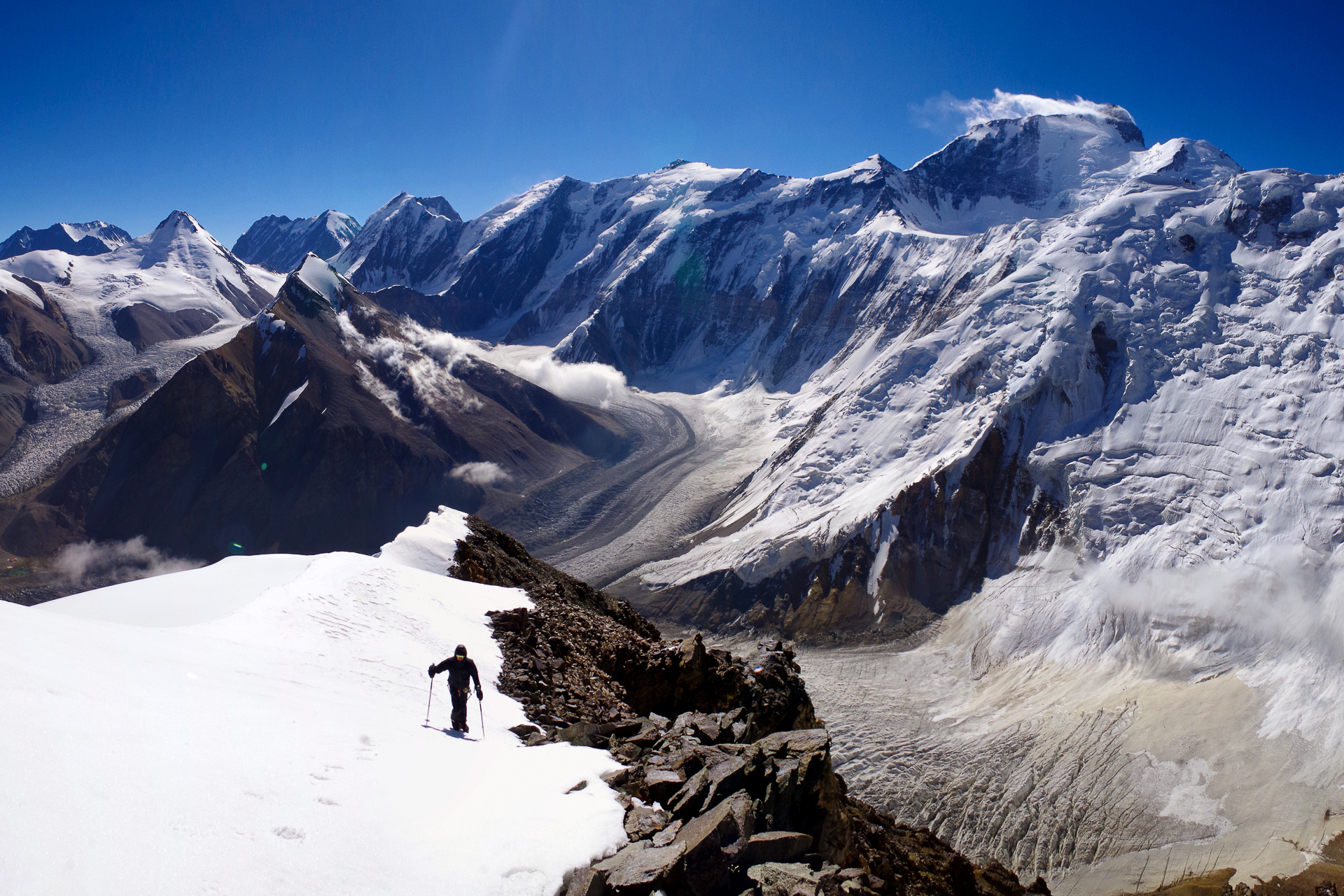
Communism Peak seen from Korzhenevskaya Peak © Jean-François Descat & Julien Delteil
In the 1960s, the USSR was in its full glory. But the borders were sealed, and Soviet mountaineers expressed their (immense) talent on the many summits that rise from one end of the former Empire of the Tsars to the other. The Himalayas were forbidden to them. But their playground was gigantic: the Caucasus, Pamir Alai, the Fann Mountains, the Greater Pamir, the Tian Shan, Kamchatka… On 12 October 1967, to encourage and reward the best in the race to the summit, the Bureau of the Central Council of Sports Societies and Organisations of the USSR decided to award a prize to those who managed to climb the five highest Soviet summits:
- Khan Tengri Peak - 7010 m on the Kyrgyzstan–Kazakhstan border
- Korzhenevskaya Peak - 7105 m in Tajikistan
- Lenin Peak - 7134 m on the Tajikistan–Kyrgyzstan border
- Victory Peak - 7439 m in Kyrgyzstan
- Communism Peak - 7495 m in Tajikistan
The reward: to become a "Snow Leopard", that almost mythical animal that haunts the mountains of Central Asia. Many would line up to obtain this prestigious "Snow Leopard" medal. But almost exclusively mountaineers from beyond the Iron Curtain, from the Soviet Union. It was not until 1985 that the first two Westerners shared this immense privilege. Two Americans, followed by a Japanese climber in 1989. Finally, in 1997, a French couple, Brigitte and Pierre Meloni, obtained the prestigious medal. They were the third couple to be awarded it. In 2011, Serge Hardy became the fifth and last Frenchman to obtain the title. Who will be next?
Expeditions Unlimited is taking on the Snow Leopard challenge with the high-mountain guide Serge Bazin, well known to French-speaking mountaineers, who has for many years guided participants on high-altitude summits.
After Lenin and Korzhenevskaya, we are setting off on the last three ascents, all of them massive, whether technically difficult, with Khan Tengri by the north ridge, chosen because it is less exposed to objective dangers; in terms of the commitment involved at very high altitude, with Communism Peak and its colossal plateau at 7000 metres; or finally in terms of objective risks, with the famous Victory Peak, or Pobeda.
Ascent of Lenin Peak (7134 m): the most accessible of the Snow Leopard
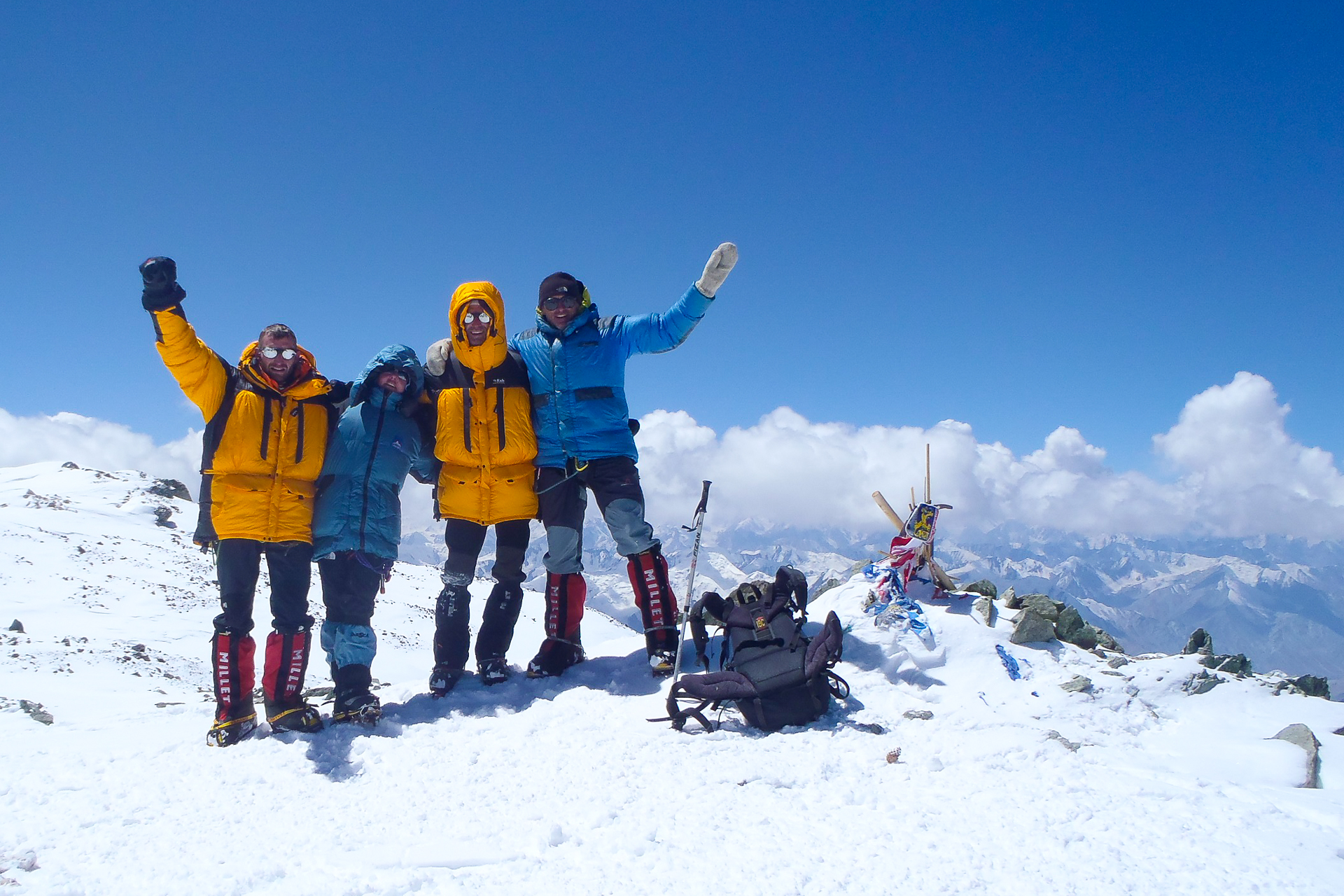
Summit of Lenin Peak © Serge Bazin
We are setting off again for the ascent of Lenin Peak, or Abu Ali Ibn Sina, this beautiful mountain whose summit is considered the most accessible 7000-metre peak in the world, sometimes flippantly, and therefore wrongly. One should not underestimate the very high altitude at which we will be operating, nor the weather, which is sometimes unfavourable, with snow and wind even in the heart of summer.
To improve our success rate, we allow 4 to 6 more days than most operators, which gives the expedition greater peace of mind, more acclimatisation time to enable as many people as possible to reach the summit and, of course, more of a weather safety margin.
We set off guided by an experienced French high-mountain guide, assisted by a local high-mountain guide during the summit push. We follow the normal route, physically demanding in the summit attempt.
To be able to join us on our next expedition to Lenin Peak, scheduled to depart on 20 July, you should not delay, as the group is already almost full.
Ascent of Khan Tengri (7010 m): the third most accessible of the Snow Leopard
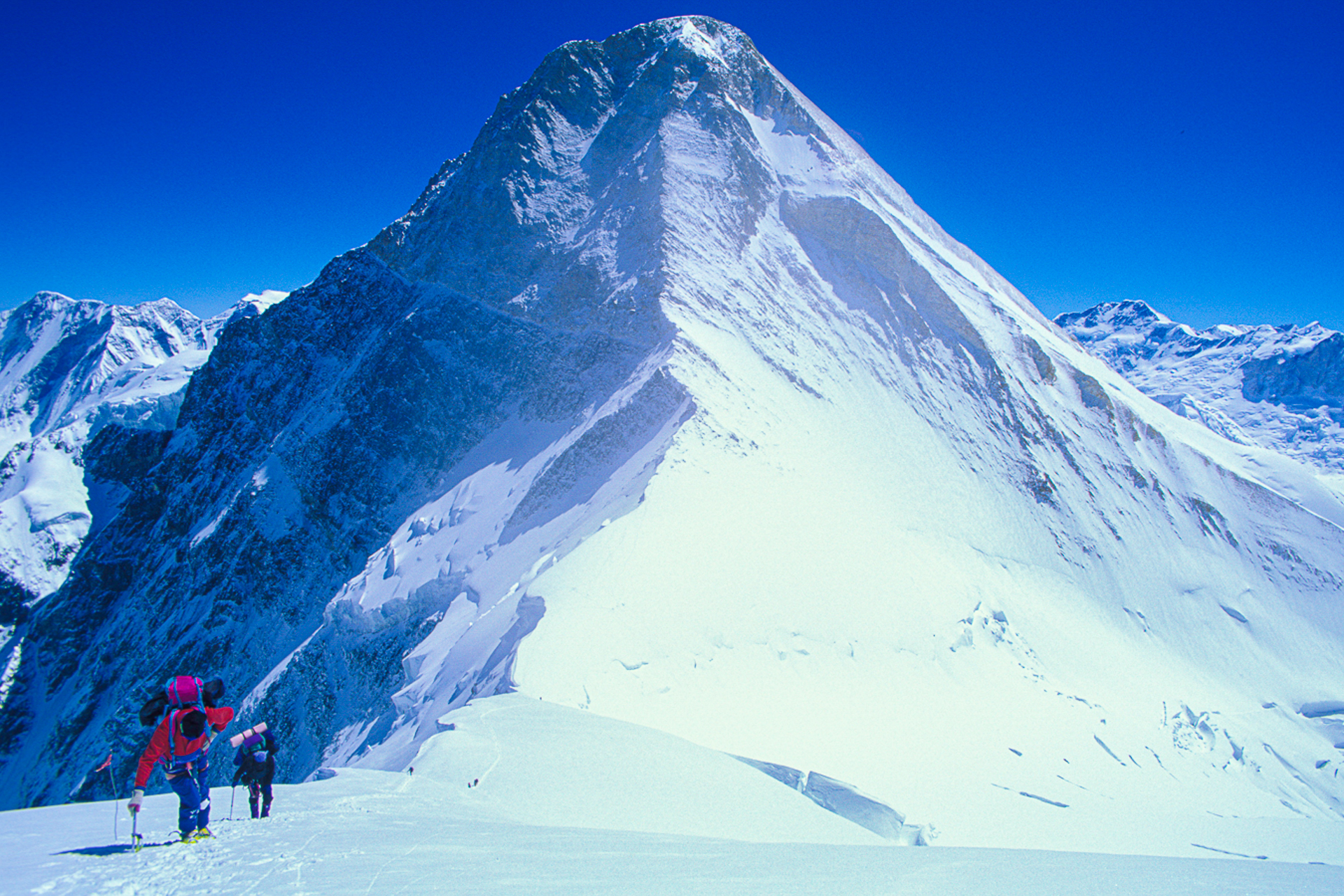
Arriving at Camp 3 on Khan Tengri © Jean-Marc Porte
The northernmost of the 7000-metre peaks and the most interesting of the Snow Leopard Challenge in terms of technical difficulty, with its "small" 7010 metres of altitude, Khan Tengri might be the easiest of the Snow Leopard Challenge... But its modest altitude is largely offset by the full range of difficulties its ascent presents. The "Little K2", as it is nicknamed by the mountaineers who know the mountain well.
We have planned to attempt its ascent by the north face, steeper but markedly less exposed than the south face to objective hazards. It makes for a long but safe route. It requires climbing to the summit of Chapaev, before descending to the west saddle where we rejoin the normal route. Access to the base camp is now made much easier by helicopter flights. The major obstacle remains the weather. The proximity of Siberia on one side and the Taklamakan Desert on the other generates violent, cold winds.
The departure of our next expedition to Khan Tengri Peak is scheduled for around 23 July, and it is intended for experienced mountaineers.

Climb Khan Tengri at 7010 meters in Kyrgyzstan
