
 Expeditions Unlimited blog
Everything has been said about Everest. Or so you thought. That was without reckoning on Jean-Michel Asselin and his ever-lively pen. Who better than the former distinguished columnist of Alpinisme et Randonnée, editor-in-chief of Montagnes Magazine and then of Vertical, could have produced this new history of the highest mountain in the world. Jean-Michel has had more than a little to do with it: 1989, 1990, 1991, 1992, 2003… For five years, four of them consecutive, he laid siege to the Roof of the World. North face, south face. Nothing would do it. The Mother Goddess of the World, Chomolungma in Tibetan, cost him dearly: work, family, home; gone, withered, broken… The final push would come to grief at the foot of the Hillary Step, on the south face. On the occasion of Everest's 70th anniversary this month, we offer you a review of his book Une histoire de l'Everest, just published by Glénat, written by our friend Didier Mille.
A book paying tribute to the great and small heroes of Everest
The motto of Charles VII's great treasurer, Jacques Cœur, carved on the walls of his château in Bourges, could apply to Jean-Michel: "To a valiant heart, nothing is impossible." Jean-Michel had the merit of going all the way to the end of his dream and the wisdom to know how to come back from it.
The same cannot be said of all the protagonists encountered along the way in this history of Everest. For Jean-Michel invites us, with his born storyteller's talent, to come and discover extraordinary characters, great or small heroes forgotten by History.
Of course, pride of place goes to the victors, Edmund Hillary and the Sherpa Tenzing Norgay, whose surnames are inseparable from the legend of the first ascent of Everest.
But in the course of a flowing, richly illustrated read, we learn that Amnye Machen (6282 m), a mysterious mountain on the edge of the Amdo province of China, came close to being crowned the highest mountain on earth: 9400 metres!
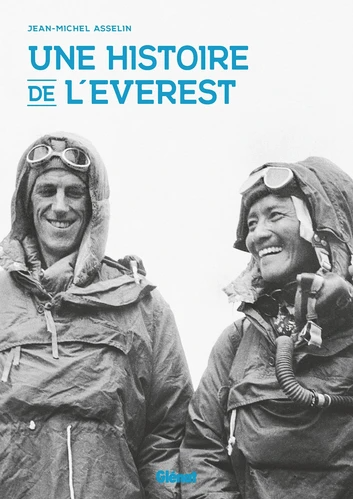
Une histoire de l’Everest - JM Asselin, Editions Glénat.
What of John Noel who, as early as 1913, was the first Westerner to approach the slopes of Everest's north face. His fertile imagination led him to envisage the construction of "a giant pipeline that would supply the climbers with oxygen, which would do away with carrying the heavy bottles".
More macabre, the unexpected encounter with the almost mummified remains of Maurice Wilson, a solitary mystic who came to grief in 1934 at the foot of the North Col. His faith was to allow him, if not to bring down the mountain, at least to carry him to the summit.
Another Himalayan climber with an unusual path, the Canadian Earl Denman, the man who walked barefoot. With Tenzing Norgay (the future co-conqueror of Everest with Hillary) and another Sherpa, he too set off, in 1946, on a solitary assault on the slopes of the north face. With the success one can imagine. At least he came back alive.
But beyond these sometimes colourful individuals (one thinks of General Charles Granville Bruce, an imposing, plain-speaking giant), Jean-Michel brings back to life a gallery of portraits whose names have the unmistakable ring of mountaineering's golden age: Dougal Haston, Don Whillans, Eric Escoffier, Bruno Gouvy… But also a fine selection of women, to whom the man, Jean-Michel, and the mountaineer, Asselin, pay a vibrant tribute: Wanda Rutkiewicz, Junko Tabei, Chantal Mauduit, Lydia Bradey, Pasang Lhamu Sherpa, Marion Chaignaud…
Not forgetting, of course, the Sherpas, heroes in spite of themselves: "On their own, the Nepalese accounted, in 2020, for 5702 ascents, out of a total of a little over 10,000."
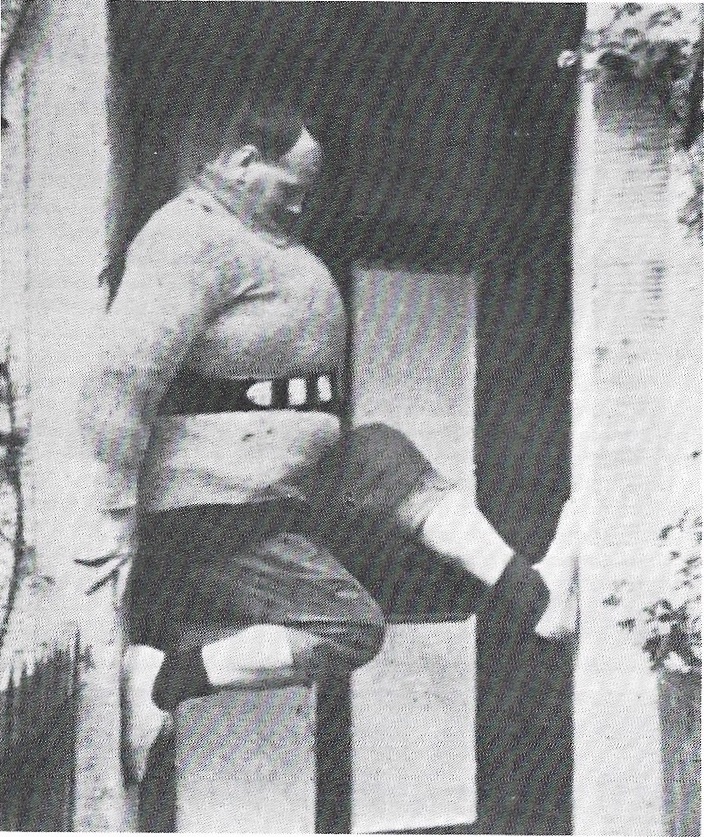
General Bruce, leader of the 1922 reconnaissance expedition. Accustomed to Pantagruelian meals, he had "quails in aspic and champagne" brought to base camp © Mountain Magazine
With this latest work, Jean-Michel Asselin takes us along the paths he loves to travel, those of Nepal and high altitude. To be read without restraint.
Extract – George Leigh Mallory, a legend or a fearless big baby?
On 12 April 1921, an old ship, the SS Sardinia, was sailing in the Mediterranean with, on board, George Herbert Leigh Mallory. Mallory, aged 35, of neo-socialist leanings, was a teacher; he was born in Cheshire, at Mobberley, on 18 June 1886. His father was an Anglican clergyman, and he had a younger brother, Trafford, who would become a commander in the Royal Air Force and, curiously, would meet his death in a plane crash on the foothills of the Belledonne range! In July 1914, George Mallory married Ruth Turner. By way of a honeymoon, the young couple treated themselves to a few nights of wild camping, which earned them being taken for German spies! Mallory had become a teacher somewhat in spite of himself, but he secretly nursed the hope of one day being a writer. In 1921, he was already the father of three children, the last was only 7 months old and had been born half an hour before his father returned from a climb in the Alps. The Everest expedition did not arouse his enthusiasm, and it is probably because Winthrop Young dangled before him the prospect that this unprecedented adventure could be of use to him for a future literary career that he agreed to go.
Mallory discovered mountaineering with Graham Irving, a climber who had created a climbing club at Winchester. He studied history at Magdalene College, Cambridge, and was a member of the rowing club. Handsome and distinguished, Mallory had suitors among the Cambridge boys. In those boarding schools, sexual promiscuity between boys was "self-evident". A journalist had written, about Oscar Wilde, imprisoned for not having denied his homosexuality: "If all the people guilty of Wilde's offences were to be put in a gaol, one would witness an immense exodus from Eton, Harrow, Rugby and Winchester to the prisons of Pentonville and Holloway." Mallory had formed friendships with Rupert Brooke, the poet, and Lytton Strachey, the notorious homosexual writer and friend of Virginia Woolf: "My God, George Mallory, he is one metre eighty tall, the body of a Praxitelean athlete and a face, it's incredible, the mystery of Botticelli." A few people nicknamed Mallory "Galahad"..
Mallory did not have a very extensive mountaineering CV; he had, however, climbed in the Alps and had even opened a route on the north face of the Aiguille du Midi, at Chamonix. He had given himself a few frights on the Nesthorn, in Switzerland, when he fell into the void. His rope partner, Geoffrey Young, had held him back by a miracle and was disturbed by Mallory's attitude, almost indifferent in the face of this fall that could have been fatal for the rope team… Mallory did not forget that he had failed in the ascent of Mont Vélan because of acute mountain sickness, but he made up for it in 1911 by easily climbing Mont Blanc. His claim to fame was, in 1913, to have soloed Pillar Rock in the Lake District National Park, a route still graded 6a today…
He was often taken for a dreamer devoid of any practical sense and, above all, of a remarkable clumsiness. The strangest portrait we have of him is these words of Tom Longstaff: "A fearless big baby and the cream of men, but perfectly incapable of taking responsibility for anything, including himself."
The 1921 expedition was essentially a reconnaissance expedition. The mountain had to be understood, the layout of its glaciers grasped, the ascent route mapped out. The "old" Raeburn proved rather incompetent when it came to equipment. No tent was provided to withstand altitude and protect against the cold that reigns there. The choice of boots and clothing, however, was left to each individual. The mountaineers had a budget of £100 each to equip themselves. It was only at the beginning of May that the whole team gathered in Darjeeling. Morshead and his surveyors set off as scouts, and everyone met up at Khampa Dzong, in Tibet. From the outset, Mallory challenged Howard-Bury's leadership. Moreover, he hardly liked Tibet: "A detestable country inhabited by detestable people." It must be said that their first steps during the crossing of Sikkim to the Jelep La took place under torrents of water. It was only from Chumbi onwards that the sky turned blue again. Very soon, intestinal troubles came to spoil things for the party; Raeburn, Wheeler and Dr Kellas were the first affected. The doctor was so weak that he practically had to be carried. Aware of his weakness, he let himself fall behind his companions. He died alone and was buried near Khampa Dzong. Soon, Wollaston, the doctor, had to make up his mind to accompany back to Sikkim Raeburn, whose health was declining. No doubt it was a relief for Mallory. From then on, the mountaineers made incessant comings and goings to explore the mountain. During one of these reconnaissances, Mallory and Bullock ventured into the Rongbuk valley, and it was there that they discovered the great amphitheatre of the north face of Everest: "We stopped, struck with amazement," writes Mallory, "when Everest appeared, all thoughts fell silent. We forgot the rocky deserts and the longing for other beauties. Without asking questions or making comments, we simply gazed." Was it during this vision that Mallory's destiny was sealed? Did he feel a true coup de foudre when he described the apparition: "The trained eye makes out other mountains, giants of 7000 and 8000 metres. Not a single one reaches the shoulder of their sovereign; with the presence of Everest, one can hardly perceive that they exist. It is by this that one recognises its true greatness."
On 20 September 1921, Mallory and Bullock, accompanied by fifteen porters, turned towards the Lhakpa La, a pass at 6750 metres. They reached the pass, exhausted, on 22 September, not without having seen footprints that the porters identified as those of the famous yeti. From this point, Mallory, Bullock and Wheeler, who had joined them, descended onto the East Rongbuk glacier, to reach the North Col, the only point of weakness on the ridge capable of leading to the summit of Everest. Mallory finally reached the North Col. Wheeler was chilled to the bone (−34°) and only Bullock felt ready to follow Mallory, who was set on climbing higher. Wisely, the men returned to base, but from now on the way up was obvious. It remained to return to England and prepare the great offensive of 1922. Mallory thus became the man of Everest.
Find our Ascent of Everest by the Nepalese south face here and by the Tibetan route.

Climb mount Everest at 8849 meters North Tibet side
