
 Expeditions Unlimited blog
Elbrus and Mustagh Ata are among those summits that hold a special place in the imagination of mountaineers and high-altitude travellers. One dominates the Caucasus, between the Black Sea and the Caspian Sea; the other rises in the far west of the Chinese plateau, on the fringes of the Pamir, Xinjiang and the great routes of Central Asia.
These two mountains share neither the same altitude, nor the same environment, nor the same history. They do, however, have one thing in common: they can suit participants in excellent physical condition, without requiring extensive experience of technical mountaineering. They remain, nonetheless, true high-altitude objectives, demanding in terms of acclimatisation, commitment and the conditions encountered. This approach echoes the spirit of the mountaineering and high-altitude expeditions offered by Expeditions Unlimited, where preparation and leadership are decisive.
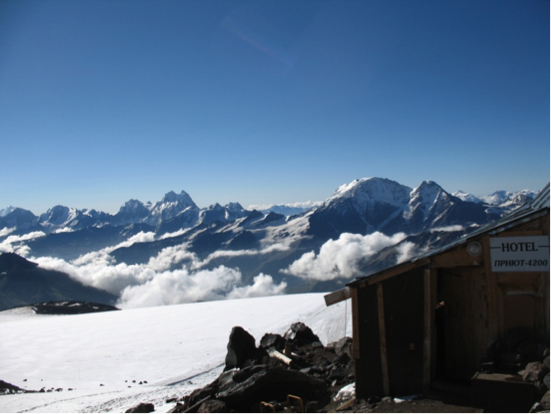
Elbrus, a Caucasus volcano at 5,642 metres
For us French and Western Europeans, Mont Blanc retains a particular aura. Chamonix is easily accessible, and the first ascent of Mont Blanc marked the beginning of the modern history of mountaineering. As a result, Mont Blanc is often regarded as the highest point in Europe. It is in fact the highest point in Western Europe, the part closest to us.
Further east, nearly 4,000 kilometres from the Alps, the Caucasus range unfolds powerfully between Europe and Asia. Its northern chain stretches from the Caspian Sea to the Black Sea over nearly 1,200 kilometres. It is there that Elbrus rises, a volcano topping out at 5,642 metres.
Elbrus is also a mountain of legend. Tradition links the Caucasus to the myth of Prometheus, chained for having stolen the sacred fire of Olympus to give it to mankind. The history of its ascent is more recent than that of Mont Blanc: the first ascent dates only from 1874, even though the summit had already been reached as early as 1829 during a Russian scientific and military operation.
Climbing Elbrus calls for excellent physical condition, good endurance and a real ability to cope with the weather, a decisive factor in success. The current programme offers the route via the north side, wilder and less frequented than the classic normal route from the south.
Ascent of Elbrus at 5,642 metres in Russia
12 days | Next departure: please enquire | Difficult level.
Mustagh Ata, father of the ice mountains
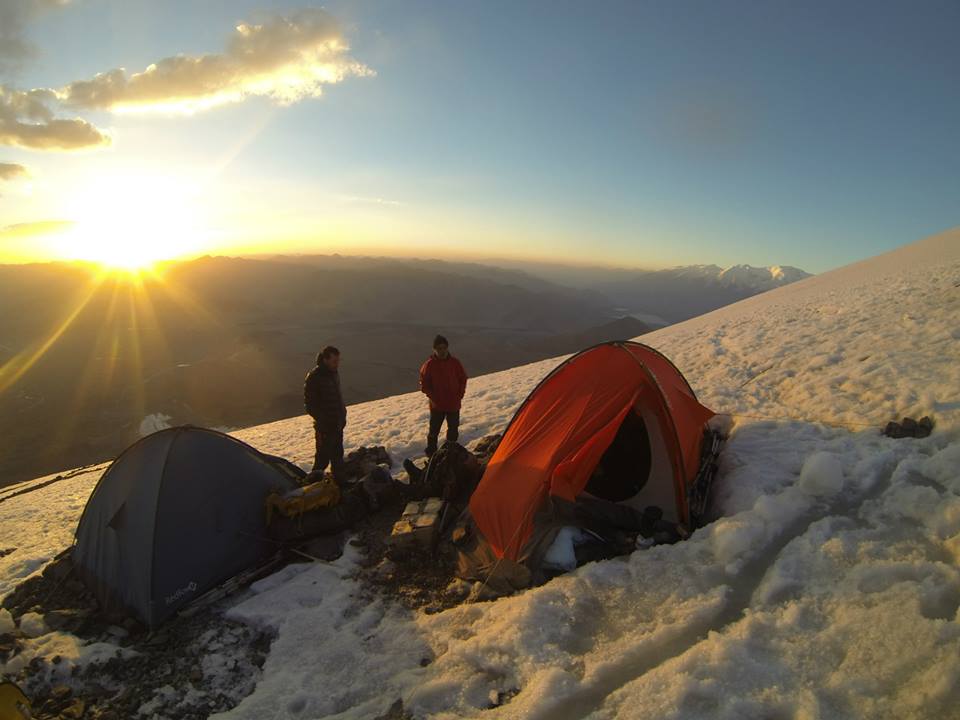
Mustagh Ata, whose name means the "father of the ice mountains" in Kazakh and Uyghur, culminates at 7,546 metres. This great massive mountain belongs, depending on the geographical reading, to the Kongur massif at the eastern end of the Pamir, or to the Kunlun Shan range, in the far west of the Chinese plateau, in Xinjiang.
Without any very pronounced elegance, Mustagh Ata impresses through its size, its glacial slopes and its isolation. It forms a magnificent viewpoint over the surrounding plateaus and ranges. It is often presented as one of the highest summits in the world accessible without major technical difficulty, and one of the highest that can be descended on skis.
Its ascent is an excellent way to test oneself at very high altitude. From base camp, the climb generally takes 12 to 16 days depending on the participants' level and their degree of acclimatisation. The main challenge is not technical difficulty, but the ability to operate for a long time above 6,000 and then 7,000 metres.
Access to base camp is from Kashgar, which means crossing very beautiful landscapes and discovering towns with renowned markets and bazaars, in particular that of Kashgar. The most favourable period for the ascent runs from mid-June to mid-September, as the monsoon does not reach this region. The current programme indicates that the expedition takes place in July–August, with a departure shown for 8 July 2026.
Ascent of Mustagh Ata at 7,546 metres in China
26 days | Next departure: please enquire | Difficult level.
Two approaches to high altitude
Elbrus and Mustagh Ata do not belong to the same register. Elbrus is a Caucasus summit — high, glaciated, but relatively short in its approach. Mustagh Ata belongs to the world of very high altitude, with a longer expedition, a progressive acclimatisation and a more marked immersion in the high plateaus of Central Asia.
In both cases, technical accessibility should not obscure the physical demands. These summits are aimed at trained participants, able to withstand the altitude, the cold, the repetition of effort and the uncertainty of mountain conditions. Their appeal lies precisely in this balance: legendary objectives, relatively approachable technically, but never to be taken lightly.

Climb Elbrus at 5642 meters in Russia
