
 Expeditions Unlimited blog
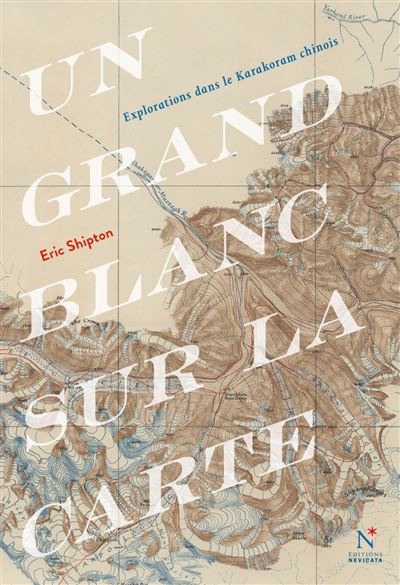
Blank on the Map was published in 1938. This gem of travel literature, the second book by the British explorer Eric Shipton, is at last available to French-speaking readers and will delight all mountain lovers. Admittedly, here there is no great summit climbed, no intense dramatic moments, and everyone comes back safe and sound. But what verve! For one really must speak of talent to be able to describe five months spent over hill and dale without ever wearying the reader. Having translated Nanda Devi exactly two years ago, Didier Mille is at it again in his mission to make Eric Shipton's cult accounts accessible to French speakers. Passionate about mountaineering and its history, he has guided many groups of trekkers across the Himalayas and collaborates with us, bringing in particular his precious knowledge and culture of the high mountains.
Find all the expeditions to 7000 metres and the expeditions to 8000 metres.
"In the middle of this void stood a stimulating word: Unexplored!"
A magic word, a veritable magnet to which the human being does not hesitate to sacrifice the material comfort of a peaceful life. Eric Shipton more than any other. The mountaineer-adventurer, or rather the adventurer-mountaineer, thus yields to the call of the great expanses of the Karakoram.
The year is 1936. Two years earlier, the young British settler, established in Kenya where he was striving to grow tea, had pulled off a brilliant feat with his companion Bill Tilman. Together they had discovered the much-coveted access to the sanctuary of Nanda Devi, the iconic summit of Himalayan India. The epic crossing of the formidable gorges of the Rishi Ganga, accomplished with more than meagre financial and human means, had convinced him that he had found his path: to the ascent of high summits, he preferred the spartan joys of exploration in a small group.
The dawn of the complete exploration of the Himalayas was barely breaking. Efforts were concentrated on Everest, where Her Majesty's worthy subjects had already been toiling away for several years. Indeed, in 1936, Eric Shipton was returning from the slopes of the roof of the world. The long hours of waiting in the storms raging at base camp had proved conducive to the imagination. Of the Karakoram, then under the domination of the British Empire, only one side was known: the southern one, which gives access to the Indian plains. The Chinese side was nothing but a "Great Blank on the map." It would be the setting for his next adventures.
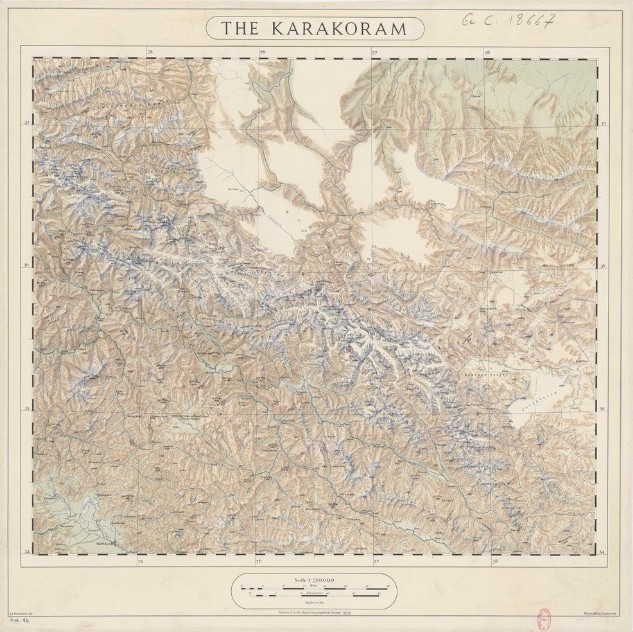
Source : Bibliothèque nationale de France.
From May to October 1937, for a little over five long months, Eric Shipton, John Auden (geologist), Michael Spender (surveyor) and the inseparable Bill Tilman set off on one of those tremendous adventures of which our Anglo-Saxon friends hold the secret. They took with them a wardrobe reduced to its simplest expression: "2 shirts each (Tilman takes only one)", and technical equipment to make you shudder: one ice axe per person! Indeed, crampons, harnesses and carabiners would not see the light of day until after the Second World War. Nailed boots had to suffice.
On the daily menu: pemmican and tsampa. The former, a "food [that] requires gradual habituation" in Shipton's own words, is "a highly nutritious meat extract, but very indigestible in paste form." The latter is roasted flour.
Seven Sherpas who had come expressly from Darjeeling (present-day India, West Bengal), led by the highly competent Ang Tharkay (whom we will find again as sirdar on the victorious French expedition to Annapurna in 1950), joined them.
In the age of satellite links, GPS and sophisticated textiles, when people hop from one summit to another by helicopter, when it isn't to come down by paraglider, reading their utterly simple epic is invigorating.
Shipton, a clear-sighted vision
If so many human activities have lost their power of attraction, it is because we tend to do things with deplorable motivations: becoming famous, giving in to sensationalism, becoming rich, or just following fashion. A mistaken attitude, based on an unreal sense of values, that pollutes us just as much as the most trivial aspects of everyday life. In life as in sport, only full awareness should count. Any other motivation diverts our mind and deprives us of the joy of living our actions in full lucidity.
For Shipton, there is no fulfilment except in unknown lands. As soon as they crossed the line separating the Indian watershed (present-day Pakistan) from the Chinese basin, not a square metre had been travelled by a Westerner, or so little. From unknown glaciers to mysterious rivers, from the foot of one Himalayan giant to another, they came and went, crossing passes that probably no Westerner will ever cross again.
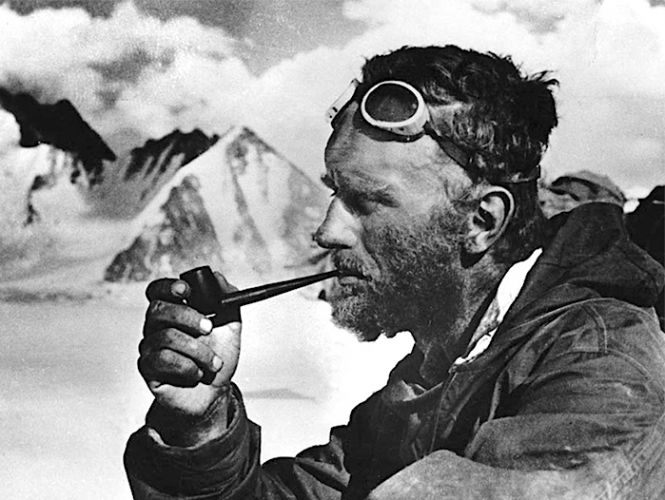
We owe to him the first description of the Chinese side of K2
The afternoon was splendid. Nothing came to interrupt the view of the immense amphitheatre that opened before me. In a single prodigious surge, the walls and spurs of K2 rose directly above us, leading in one sweep to the summit, 4000 metres higher. What I saw was beyond my understanding. Fascinated, humbled, I sat there, contemplating the impossible.
Falls into crevasses and crossings of swollen torrents nearly put an end to the adventure. Nothing stopped them. The days began at dawn and ended in the dead of night, could fatigue have been unknown to them?
The expanses to be covered were so vast that they ended up splitting into three groups. Tilman took on the task of solving the mystery of the Snow Lake, that immense stretch of snow at the top of the Biafo and Hispar glaciers. It was then thought to be a kind of ice cap, with no outlet. Auden ventured into a labyrinth of crevasses and seracs from which he would have great difficulty escaping. Shipton and Spender travelled the immense Braldu glacier and reached the improbable village of Shimshal, the very end of the world.
Michael Spender, helped by Shipton and Tilman, was the first to give the world a magnificent map, entirely drawn by hand, of the Karakoram, from Shimshal to K2 and the Gasherbrums. The heavy theodolite, indispensable for making the surveys, did not win everyone over. We learn that Tilman, "whose feelings towards this cumbersome instrument bordered on animosity, restrained himself from sending it off into the void for good."
Eric Shipton, a consummate storyteller, gives us his impressions with humour throughout the journey. Humanity, humility, humour, Eric Shipton's entire book can be summed up in these three values.

Climb K2 at 8611 meters in Pakistan

Climb Nanga Parbat at 8126 meters in Pakistan
