
 Expeditions Unlimited blog
9 May 1956, 12:30 p.m.: the Nepalese sirdar Gyalzen Norbu (37) and the Japanese Himalayan climber Toshio Imanishi (41) stand atop the narrow rocky summit pyramid of Manaslu (8156 m). For the first time, the summit of Manaslu is set foot on by humans. It took several attempts to succeed in climbing the eighth-highest summit in the world, which even today remains a legendary ascent in a mountaineer's life. Our colleague and friend Didier Mille, a high-mountain guide, looks back on this extraordinary epic.
Manaslu, an Asian victory
9 May 1956, 12:30 p.m.: the Nepalese sirdar Gyalzen Norbu (37) and the Japanese Himalayan climber Toshio Imanishi (41) stand atop the narrow rocky summit pyramid of Manaslu (8156 m), the eighth-highest summit on the planet. Japan enters the inner circle of nations, until then all Western, to have climbed the peak of an 8000-metre summit untouched by any previous ascent. A symbolic victory, allowing the "land of the rising sun" to hold its head up proudly!
A crowning achievement for Gyalzen Norbu: on 16 May 1955, a year earlier, he had set foot on the summit of Makalu (8463 m) alongside Jean Franco and Guido Magnone, the day after the victorious ascent by Lionel Terray and Jean Couzy. Two 8000-metre peaks in 12 months to his name probably gave Gyalzen the record of the time.
Five successive expeditions, all sponsored by the major national press group Mainichi and organised within the framework of the Japanese Alpine Club of Kyoto, contributed to the success.
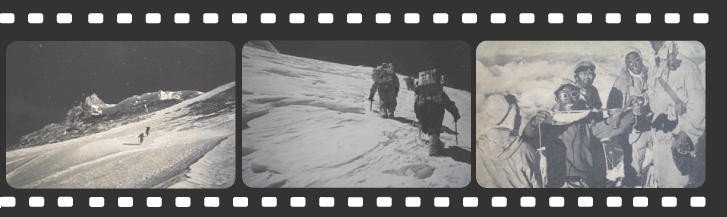
Archive images
The beginnings…
1951: the English explorer and Himalayan climber Bill Tilman comes down from an attempt on Annapurna IV. He takes the opportunity to explore the upper valley of the Dudh Khola. He brings back a photograph of Manaslu: an access route via the west face seems possible.
The first attempts…
1952: armed with the photo taken by Bill Tilman, a first Japanese expedition explores the west face. Conclusion: impassable. The team then climbs back up the Dudh Khola, crosses the Larkye Pass and descends to Sama, the first large village on the way down from the pass, in the Buri Gandaki valley. A glacier coming from what appears to be the summit plateau of Manaslu would be the key to the ascent. Return to Kathmandu via the Buri Gandaki: the first circuit of Manaslu has just been completed, in the opposite direction to the current one.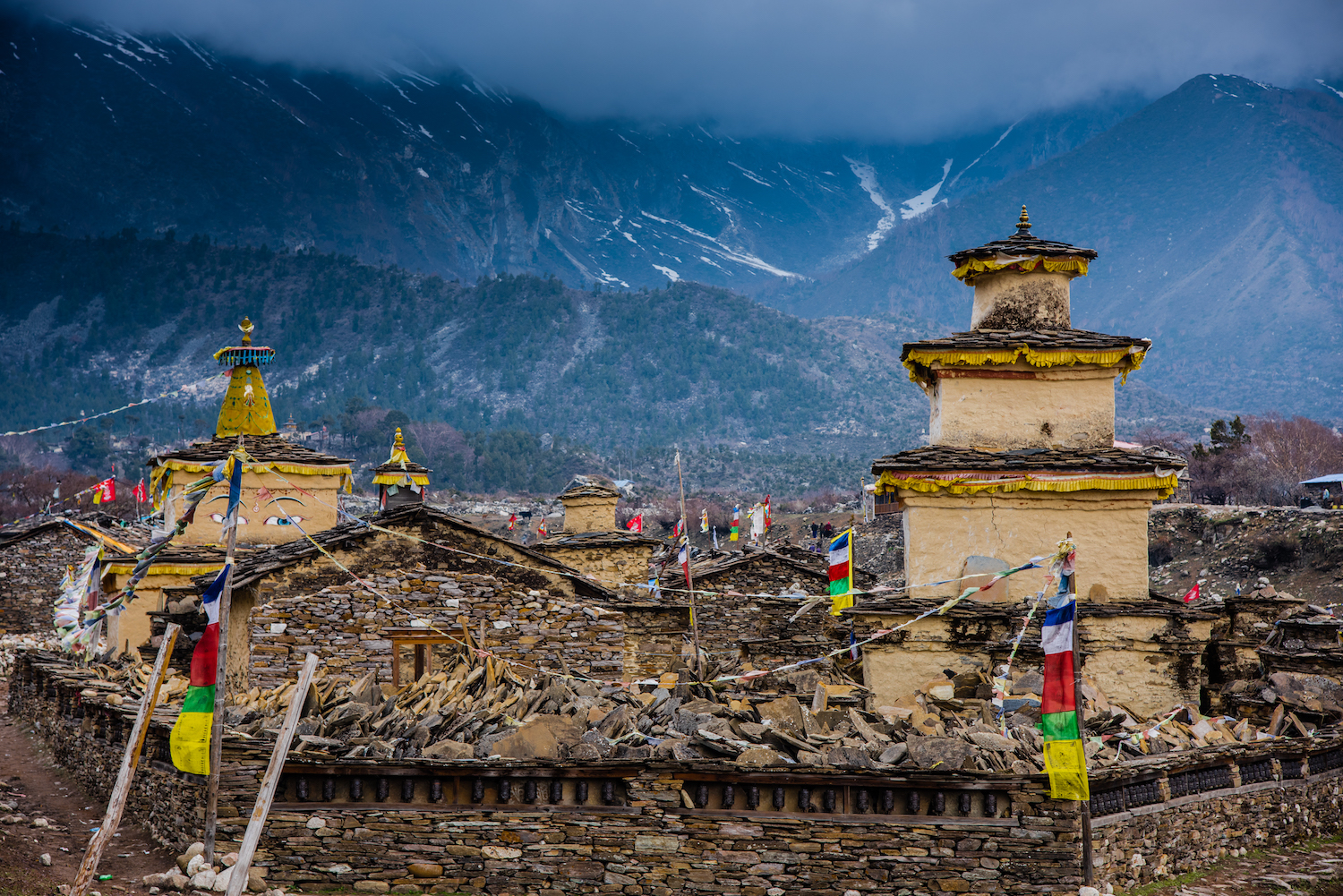
The village of Sama © David Ducoin
1953: first serious expedition
Made up of 15 members and 2 scientists, it narrowly misses victory. No fewer than nine camps are spread up the mountain, the last at 7500 metres. Having no oxygen apparatus, the climbers, at the limit of their strength, give up at 7750 metres, 375 metres below the summit, a fine feat. But the goddess of the mountain is moved by this near-success: in anger, she unleashes an avalanche that destroys the gompa (monastery) of Sama, the last village at the foot of the Himalayan giant and an unavoidable waypoint towards the base camp.
1954: encouraged by the previous experiences, the Japanese see victory taking shape. The 14 members gathered together, several of whom took part in the previous year's attempt, come back raring to go. Alas! At Sama, the encounter with the villagers, heated from the start, nearly turns into a brawl. There is no question of profaning the mountain a second time, at the risk of once again triggering the wrath of Kantung, the protective goddess. Every attempt to negotiate proving futile, the entire group turns to the Ganesh Himal (today's Tsum Valley trek). But they fail to find a route of access to the summit and return empty-handed.
1955: the Japanese Alpine Club sends two eminent members to the Nepalese government to negotiate with the inhabitants of Sama. But the authorities have little sway over the village, which is far removed from the capital. For centuries, the salt caravans coming from nearby Tibet have come to Sama to exchange salt for rice. The "Subbah", an indispensable trader for the exchanges between the "Bhotias" of Sama and the Hindus of Kathmandu, takes charge of the negotiation. Thanks to his talents, he obtains the agreement of the inhabitants of Sama: they will let the next expedition pass! In the autumn of 1955, three mountaineers come to reconnoitre the access to the summit plateau, thus confirming the route to follow. True to their commitments, the villagers authorise their passage.
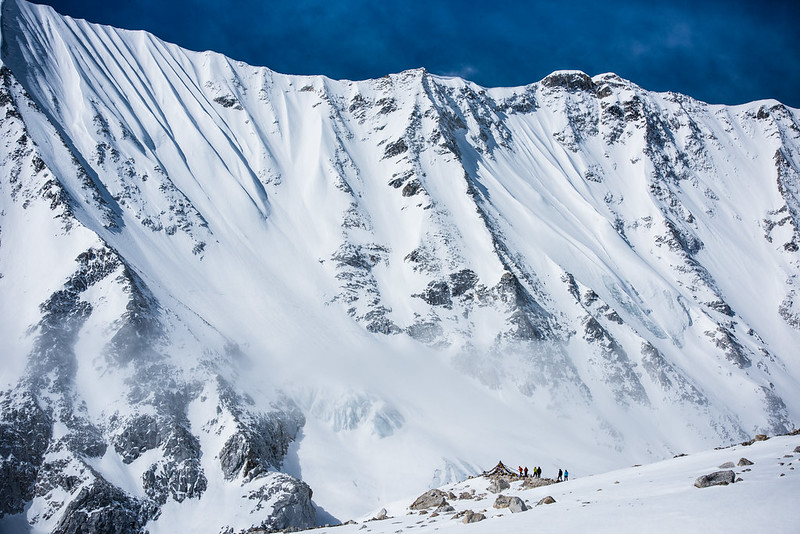
Larkye Pass (5 135 m) © David Ducoin
On the road to glory!
1956: the 12 members of the expedition, accompanied by 20 Sherpas hired by Gyalzen Norbu, set off from Kathmandu on 11 March. They reach Sama on 26 March, the key to accessing the base camp. A crucial moment. Will the villagers let through these foreigners by whom misfortune has already struck? In the end all goes well, on condition that people from the village be hired as porters up to the base camp.
The expedition, led by the most famous Japanese mountaineer of the time, Yuko Maki (62), is about to enter history. Yuko has a fine record to his name: the first ascent of the Eiger by the east ridge (Mittellegi) in 1921, the first ascent of Mount Alberta in the Rockies in 1924, and the Matterhorn in 1926. Drawing on his past experiences, Yuko Maki plans to reduce the number of camps: six should suffice. He himself will go as far as Camp II (5600 m), from where he will coordinate the final assault. Another essential element of the expedition: the development of the oxygen equipment devised by Dr Hirokichi Tatsunuma, a member of both the 1952 and 1953 expeditions. A generator, carried up to Camp V at 7160 metres, supplies oxygen for the night and for all the tents. Dr Tatsunuma, despite the altitude, busies himself and prepares eight complete sets of equipment, each consisting of three oxygen cylinders.
On 8 May, the tireless Junjiro Muraki (32, a member of the first two expeditions) and five heavily laden Sherpas set off. Objective: to set up Camp VI at 7800 metres. Toshio Imanishi and the sirdar Gyalzen Norbu follow later in the day, conserving their strength for the morrow. At 1:30 p.m., they join their teammates on the summit plateau where the latter are pitching Camp VI. Muraki and the Sherpas go back down to Camp V. Imanishi and Gyalzen remain alone for the vigil before battle.
9 May 1956, Camp VI, 7800 m, −22°: a cloudless and, above all, windless sky proves a good omen. Wake-up at 5:30 a.m., departure at 8 a.m. At this altitude, melting the snow for the final breakfast takes time… Imanishi and Gyalzen set off slowly: the packs weigh 20 kg! Three oxygen bottles, down jackets, a little food, a few pitons in anticipation of rocky sections and, above all, three different cine and still cameras with their film. Immortalising the victory matters as much as the success itself.
11 a.m., 7925 metres: once the summit plateau has been crossed, twenty steeper metres require steps to be cut. A gruelling exercise at this altitude, made worse by the weight of the pack. The two mountaineers take turns cutting steps. They then climb a ridge fringed with a treacherous cornice and think they have arrived… But the small rocky summit pyramid seems to taunt them. They have to descend ten metres into a couloir, plant a piton to belay themselves, and laboriously climb the last few metres of broken rock.
12:30 p.m., 8156 metres: victory! ,%20Manaslu%20round.jpg)
Larkye Pass (5135 m), Manaslu Round © David Ducoin
Fifteen years later
After this Homeric ascent, Manaslu falls back into its age-old solitude, to the great delight of the Bhotias of Sama. It is not until 1971 that a new expedition, once again led by Japanese climbers, takes on the north-west spur. A route of great difficulty, including, between Camps III and IV, a rocky step 250 metres high. Some climbing sections, graded VI and A2, push back the limits of high-altitude climbing at the time. Summit on 17 May for two members of the expedition.
Tragedy
In 1972, an Italo-Austrian team sets off up the slopes of the difficult south pillar. Reinhold Messner, already famous, makes the third ascent of Manaslu and the first solo ascent. Unfortunately, on the descent from Camp IV (7800 m), two members of the expedition vanish in the storm.
First female ascent
Japanese women mountaineers make their mark in turn in 1974. The first ascent, by a female team, of an 8000-metre peak. They followed the original route, opened in 1956.
The French too
In the autumn of 1981, French mountaineers burst onto the Japanese playground.
Pierre Béghin, the guide Bernard Muller and two mountaineers from Grenoble, Gérard Bretin and Dominique Chaix, embark on an ambitious project: the west face of Manaslu, without oxygen. A wall deemed impassable by the 1952 expedition. Equipped with nothing more than a photo of the west face, they prepare to take up the challenge. The route: right in the middle of the face, the only spot more or less "overlooked" by the avalanches. The difficulties promise to be many. On 7 October, after bivouacking at 7400 metres, Pierre and Bernard reach the summit, thus achieving their first 8000-metre peak.
BONUS: DISCOVER THE FILM OF THE ASCENT
This is a Japanese site with no English translation, but you will find beautiful, previously unseen archive footage there.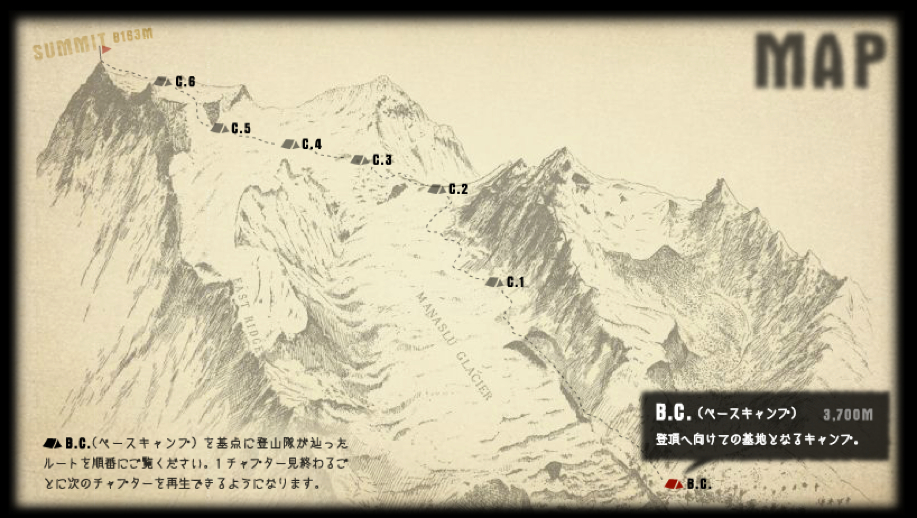
Your turn?
If you undertake the ascent of Manaslu, organised in spring 2021 by Expeditions Unlimited, do not be surprised at the number of Japanese climbers you meet. To each nation its favourite mountain. Annapurna for the French, Everest for the British, Nanga Parbat for the Germans… and Manaslu for the Japanese.
Find out more about the Ascent of Manaslu at 8156 m with Paulo Grobel.
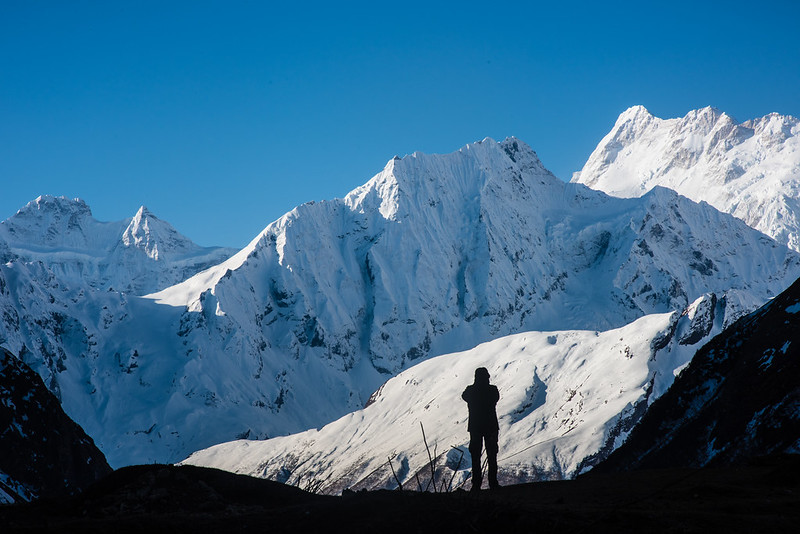
Samdo Peak and Pangbuche Himal seen from the village of Samdo © David Ducoin
Bibliographical sources:
- Grande Encyclopédie de la montagne (éditions Atlas 1978)
- The Himalayan Journal vol 20
- Nepal, Himalaya - HW Tillman, 1950

Climb Manaslu at 8163 meters in Nepal

Climb Annapurna at 8091 meters in Nepal
